Showing posts with label Writer -K.. Show all posts

Friday, August 2, 2013

Feminine Voice of Reason


Pacific Rim hit theaters just a little while back and made over thirty-seven million dollars during its opening weekend. It is an action-packed film, and for a movie about large robots fighting off hulking monsters, it has a surprising amount of story. If you haven’t heard already, Pacific Rim has a woman of color as a main character but, sadly, the film still does not pass the Bechdel Test. There is another female robot pilot, but she has almost no screen time and very few lines, and in the background only a few women can be picked out of the crowds of the main setting. But there is one familiar female voice that graces the screen, that of Ellen McLain as the voice of robot Gipsy Danger.

There has been a rise in the use of fictional computer voices, artificial intelligences, and virtual intelligences in recent years, accompanying the rise in science fiction’s popularity.  Voice actresses, such as Ellen McLain, portray voices that are mechanized, concise, educated, informative, and helpful. And it is almost always feminine. This can most prevalently be seen in the realm of video games, where science fiction and computer advancements have always been part of popular game design. For female-voiced AIs, video games and movies are their domain.

GLaDOS from Portal, voiced by Ellen McLain

Ellen McLain, most recently voicing the computer of the main robot from Pacific Rim, is most well known for her voice work in the Portal franchise. While McLain’s GLaDOS (Genetic Lifeform and Disk Operating System) from Portal may be one of the best-known AI/VI voices from video games, the line goes on. From the popular Halo series the AI Cortana (voiced by Jen Taylor) assists and informs the player, but also evolved to be more sexualized as the series and graphics allowed it to. From Mass Effect 2 and Mass Effect 3 there comes EDI (voiced by Tricia Helfer), a female voiced AI that chooses a provocative robotic female body to integrate with.  Going farther back, before the turn of the century, there was the intense computer SHODAN (voiced by Terri Brosius) from the System Shock series. Some of the most memorable computer programs from the last few generation of game consoles have been vocalized as feminine.

SHODAN from System Shock, voiced by Terri Brosius


Why is this?  With the recent backlash at the video game community for its lack of strong female characters, it is interesting to see that many of the ‘fake’ people or minds in video games are portrayed as or performed as female.  Artificial intelligences are not true people, but the prevalence to refer to GLaDOs as ‘she’ instead of ‘it’ remains.  These computers contain a mixture of stereotypically gendered traits, from the feminine gracefulness to the masculine lack of emotion. But these computer programs share a lot of traits with successful women in the workplace; they are effective, hard working, confident, knowledgeable, and self-reliant. Given this there is still, in most cases, no realistic middle ground; these AIs are either helpful, following orders as an artificial assistant, or they are cruel, manipulative and against the player character.

The evolution of Cortana's appearance.
Sadly, it seems that video games create more female voiced or bodied avatars when they make them out of metal instead of bone.  This trend is changing as reimagined classic female characters reemerge and new characters are created, but video games still have a long way to go in character equality. Fully-fledged female characters in video games are still hard to come by, but these exaggerated, objectified feminine computer programs are actually very well known and persistent.  Video games have a bad reputation of objectifying women and organizing female characters by tropes. While characters such as GLaDOS and SHODAN are loved, these AI characters are not doing video games any favors towards more realistic interpretations of women.  While these AIs may be viewed as intelligent women, some are sexualized without choice or representation. While Halo’s AI Cortana started off as blocky graphics back in 2001, her most recent rendition depicts her as a seductive and naked digitized woman. Mass Effect’s EDI implants her own consciousness into the empty robotic shell of a metal femme fatale.  It is noted throughout the game that EDI has chosen to inhabit an attractive form.  With their attractive bodies they are also mostly void of emotion but brimming with information and assistance.

The use of feminine-voiced computers has allowed video games and movies to give us some beloved characters, but there is a clear split between those that use it to represent a creation of intellect, or a creation meant to objectify the female form. It is interesting to note that the helpful female AIs are usually given attractive female forms, while those who are independent and usually malicious are abstract voices. 

As the realm of science fiction expands, computer graphics increase, and stories continue to be written, it will be interesting to see how the artificial and real women of video games and movies are represented. AI characters are a wonderful addition to science fiction and allow for great story expansion. Yet these artificial female representations do not create a pass for appropriate objectification, especially if the AI is the only slight version of female representation in the film or game.  When a high-budget summer release such as Pacific Rim can still fall short of the Bechdel test, and video games are still under fire for their lack of strong female characters, certain changes have already been called for. Adding to those, a change in the way mechanical humanoids are used, in some but not all cases, to exploit the female form and emphasize stereotypical feminine traits. 

Thursday, July 4, 2013

The Guide to Gaming Children


      The opportunity to play video games at a young age is a great step forward in educating children about technology and modern electronic interaction. Children of the technological age are growing up with skills that my parents are still taking time to learn. These skills will give gaming children a great boost towards understanding what will become their everyday world (not that I don’t support good old-fashioned stick fighting, tree climbing, and outdoor play).  Because video games can be so beneficial to these parts of a child’s life, as well as boosting imagination, motor skills and much more, it can be a great bonding activity for parents and their children.
      There are of course games that are made for children spanning all ages. There are games for infants, such as flash games that simulate peek-a-boo. There are those that follow popular children’s TV shows or movies, such as Disney’s many games.  Educational games, such as those that teach math or spelling, are made for classroom and at home use, but they are not the only manner in which video games can become educational.  There is a plethora of ways to make games not intentionally built for educational purposes educational.
Gaming Fun for All

A recent video by Extra Credits took on the topic of parents using games to the benefit of their children and the relationship they have with their children. Their examples prove that even games such as Grand Theft Auto or Call of Duty can open up a child’s mind to the greater issues that games discuss or are based around. It even brings up the ever-important idea of cross-media research and non-gaming interaction. One of the most beneficial things non-gaming parents can do to show interest in their child’s gaming hobby is to sit with them and attempt to assist them. Giving a child a game should not be a cop-out on parental interaction, especially if the child has a great interest in games.  It should be seen as an opportunity for bonding, an opportunity to become part of the child’s hobby.  It can be a great experience for both the parent and child.  A parent sitting down and fervently translating a cypher while their child breaks through an Assassin’s Creed II glyph can be just as engaging and supporting as attending a child’s soccer game.
      The example above also shows how a game can open up great avenues of conversation. Games like Assassin’s Creed II open up questions and conversations about geography, history, cryptography, realms of science fiction, and much more.  Almost every game can be broken down into ideas worth discussing. An educating game does not have to be an ‘educational game’. 
Gender: Sex: Trait: Role - Very little choice
      Cooperative games are also a great device in the family bonding tool-kit. For younger children, playing a game from the LEGO franchise with their parents will build teamwork skills and perhaps act as a trust building exercise. It is also important to think of the impact games have on a child’s idea of gender roles. Playing games like LittleBig Planet will not only let a child’s imagination run wild, but through creating there own little Sack-avatar they can play with what it means to make representation of themselves (or just a mustached cook with a purple afro), which is far less constricting than some older games (Harvest Moon 3’s, ‘Are you a boy or a girl?’).  It is important to sit down and discuss the gender stereotypes seen in most games, and then choose games with less constricting and more positive views on individual differences to counter the negative input.
      In some ways it is up to gaming parents to protect their children from some of the negative aspects of video games they are not yet prepared for, but it is also up to them to use video games as a positive, educational, and constructive tool.  The video game industry and these games’ influences are growing every year.  Rather than skip out on this opportunity due to the media through which it is presented, parents should look for ways to enhance their child’s gaming experience.


-K.


As an endnote, I should state that I am not a parent. But as a child who played video games I sometime had a great time playing with my parents and siblings. To this day my family still uses video games as entertainment and bonding during family visits. I am glad that my parents took the time to show interest, and that they continue to do so.

Tuesday, June 25, 2013

What’s All the Hullabaloo About?


Earlier on this blog we may have touched on the recent Tropes Vs. Women in Video Games  controversy, and while I don’t believe we contributed a full post to it, it felt as though everything that had to be said had been said.  Now that the first two sections, both touching on the Damsels in Distress trope, have been posted and the internet has responded in its total manner of chaos blended with intellect, the truth is really there. Is this really the product that every mean-hearted, trolling, and down-right horrible post was scared of? And, yes, in my opinion they were scared. They were scared that this project would somehow damage or break the walls of the gaming community, the ‘gamer’ identity, and the realm of gaming that has for so long presented itself as being open.
But, as discussed on a previous post about the 'Gamer' identity, the ‘Gamer’ label is in itself exclusionary, and the realm of gaming does have walls.  Did these trolls and harassers think that the walls they spend so much time building and reinforcing were going to be so easily broken by one web series about women in video games? I could only hope. But no, those walls are strong, and the exclusionary, predominantly white heterosexual male girders holding them up are not easily taken down. 
Anita Sarkeesian’s first two released videos are tame, very much so. These videos brim information, with detailed research into the history of the Damsel in Distress, the history of video games, variety of the trope, a multitude of both modern and more classic games, and how the Damsel in Distress trope was transferred over to video games from earlier media.  Anita appears to have taken great care in ensuring that her videos can reach a wide audience.  While I am sure that she is fully capable of in-depth feminist discussion with the appropriate jargon, she presents herself and the information in a wide-reaching manner.  This allows for an open audience and open discussion between its viewers. 
This makes it even less threatening in some ways, and more in others. The videos are clear, concise, and intellectual and can be understood by all. Those trolling harassers can see her side of the argument in full, plain view and they can no longer fear that it will be feminist jargon, going over their heads on purpose to alienate them from what is attacking them.  There is no alienation, the video is all access. So, this is less frightening. But then comes the more frightening.
Because everything is so clear Anita can get her points and her research across quickly and efficiently. And for viewers like myself, it is a frighteningly large amount of information on just one of the several tropes she will be exploring in her series.  The pure amount of information, of games that conform to these tropes, is overwhelming. As a female gamer I now spend a portion of time examining games as I play and enjoy them. But I did not do so when I was younger or until just a few years ago.  Just the massive amount of games I have played that were on her list upset me (For the list, please visit this link for the Damsel in Distress Video).  
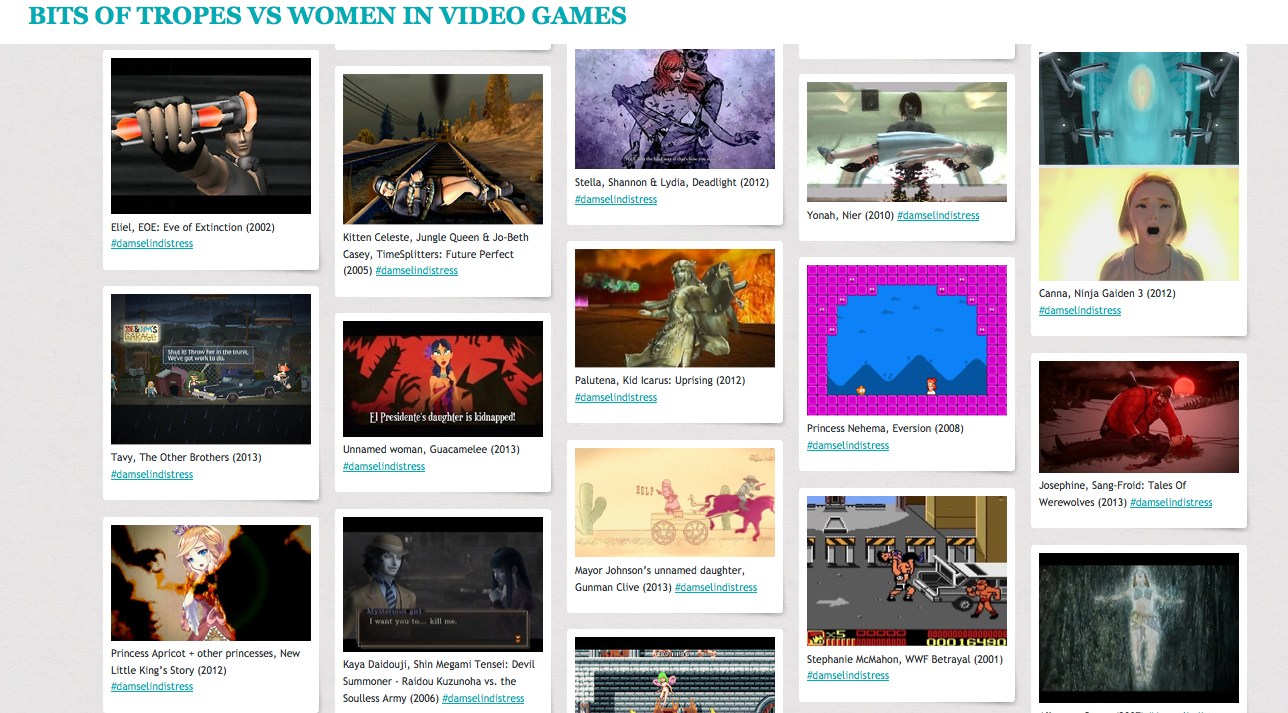
Check out all the example of a Damsel in Distress over at the Tropes vs. Women in Videos Games Tumblr.

The trope of Damsel in Distress not only permeates a large number of games, but it does so in such varying manners as to have subsets.  She examines these subsets not only in how they change gaming, but how they effect and have been effected by additional types of media. And it is so common. These tropes are being used to pump out low quality games with poor storytelling just to force feed the gamer mind. A Forbes contributor, Jen Bosier, said it just as I wanted to, “This isn’t just demeaning to women, it’s demeaning to gamers in general”.
            I want better games, for everyone. And that means creating in-depth stories that are not demeaning for the ever-expanding gaming community. These videos should in some small amount be feared, they are airing out the video games community’s closet and showing the world that, yes, things do need to change. 

-K.

Monday, June 10, 2013

The Art of the Fantastic

-->
I had the great luck to be able to attend Spectrum Fantastic Art Live 2 just a little while ago.  The drive to Kansas City, MO took far longer than I should have wished, but it was well worth it. The variety of great artists filling the gallery hall was a site I will remember in both my memory and my photo album. These are the paintings that inspire children to dream of dragons, for men and women to visualize as they read through books to escape their lives for a short time, these are the pieces that create a world beyond the real.  While my main objective for this trip was to enjoy the fantastic art I have loved since childhood and to have informative conversations with artist of a far better caliber than myself, I always have secondary objectives. 
Spectrum 20 Award Gala, Beautiful


Walking around the hall, rows of paintings, sketches, sculptures, and live demonstrations, it is easy to identify some of the classic depiction of sci-fi and fantasy women. Sadly, these classic depictions are most commonly that of the Damsel in Distress, the Evil Seductress, or the Power is Sex(y). There were rows upon rows of booths, but within those rows, hidden sometimes at the corners, these upsetting depictions of the women in sci-fi and fantasy were still alive. At one point I began to notice that some of the paintings, prints, and illustration that had more graphic sexual content were being censored with small slips of stick-notes. They were stuck on, hiding nipples or genitalia, while the rest of the picture was open for the viewing public. The picture of the chained woman with the distressed face and her legs spread, the exposed captured woman being taken off, the seductress enthralling onlookers with her sexual power, were all okay for viewing, all undamaging, as long as those few key pieces of anatomy were covered.  Seeing this it gave off a sad message: Viewing women as disempowered and objectified is fine, so long as that sticky-note stayed were it was stuck. I know this may have been for the sake of the children, since both artists and spectators were free to bring their children and some certainly did, but that does not really make the situations any better in my opinion. By blocking off those parts, but not the image it self, it may make it appropriate for public viewing, but it certainly does not decrease the impact it would have on how a boy views women or how a girl will choose to view herself.
I would like to clarify that I am not at all opposed to nudity in art. Nudity in art has existed since the beginning of art itself. The human body can convey power, grace, beauty, sexuality, environmental interaction, and the spectrum of human emotion.  David Palumdo's Fed is a great example of the power nudity can convey to an image. It is a disappointment when these such powerful works are overrun by the objectified and over-sexualized female figures so common in the sci-fi and fantasy world.  Again, though, similar to the argument about who has the power in what children see if video games, who has the power to change what is seen on book or comic covers?
Dan Dos Santos, a great artist I had the pleasure of meeting at SFAL2, was indirectly accused by a BBC article of being sexist in his works by using one of Dos Santos’ works as the example for sexist science fiction art.  The article goes on, giving other examples including the classic Conan depictions. The article brings up a few good points, such as how “many science fiction and fantasy readers are disappointed to encounter everyday sexism in a medium that is supposed to offer an escape” (which is similar to the immersion-problem many feel when playing video games).  It also points out that many science fiction covers, classic and modern, are still created to attract a heterosexual male audience, even though the amount of science fiction and fantasy female authors and readers, as well as members of the TGLBQ community, is on the rise.  One of the most powerful, and true, lines from the BBC article comes as a quote from Tracy Hurley:


"Male characters [are] powerful and strong, and women's sexuality will be emphasized. And why is that a problem? It's constraining for both men and women."

Art Hall, filled with fans, both men and women.
In response to this indirect critique, the artist collaboration blog Muddy Colors responded internally with a post by Arnie Fenner, retiring co-director of the long running Spectrum books that inspired/created the whole SFAL event.  Arnie brings up the key of the whole issue in his post Objectify:


“But unless I'm missing something, here's the thing that bugged me about the BBC article and Hines' cosplay: the artists get the "blame" for what appears on the books' covers. Not the writers whose stories and descriptions lend themselves to the interpretations being decried; not the publishers, not the editors, not the art directors, not the sales reps, not the retailers, and not the consumers. All of whom dictate what the commercial artist creates and delivers. If they don't approve, if the artist doesn't follow direction and give them what they're paying for, the art is never seen. If the customers don't buy the books, other solutions are sought.”


I agree, mostly. I agree that it takes a whole line of people from writer, to an art director, to an artist, to a publisher, to the consumer to create the sphere of influence in which these art pieces (both written and visual) can exist.  There is no easy solution. It is a whole cultural setting in which the realm of the idealized men and objectified women is written about, enforced, and portrayed. No individual or part of the chain of creation can be completely at fault, and blame cannot be so easily delegated.

            So, when a talented artist such as Dos Santos creates works such as the one critiqued by the BBC article, it took several stages for it to become that particular piece. The writer created the character, the art director gave input for the work, and the art was completed through the views of several people, not the artist alone. Also, to have called out an individual piece without these correct justifications was an obvious mistake. Sexist and objectified depictions, in video games, in comics, in the world of Fantastic art, do not exist in a vacuum and do not under the majority of circumstances come into the public view through the work of an individual.

            I’ve heard it said that in the art world that you have to take the jobs offered to you. To start off, you need all the money, work, and publicity you can get. Young artists, or artists just starting off, may find that falling in line with these constricted image types is the best way to begin a career, but this will only continue to perpetuate these images for years to come. Once set in their career, artist can choose to be picky. Steven Belledin, another artist I have had the great opportunity to meet, never compromises his values in his depiction of female characters.  He has said that this has at times put him at odds with those offering jobs, but I would like to assure him that for some viewers and new artists just knowing that not compromising is an option is a light for a better future. 

-K.

Sunday, April 28, 2013

I Didn’t Hear You Correctly, Did I?

    While this article may not be within the realm of video games, I would still like to take time to comment on comics when I feel the need arises.  It is important to note that comics are another section of the ‘geek’ subculture to which games are also bound. Also, as I refer here to those characters existing within the Batman/Gotham DC Universe, it is important to know that just like this franchise, comics and games have had a border-crossing relationship for years.

    A while back I began reading the Gotham City Sirens, I got the whole set after enjoying the first few and I have been slowly working my way through them since.  After a group discussion about the interesting article by Rebecca Demarest, ‘Superheroes, Superpowers, and Sexuality’ I decided to take another look at the first issue.
Gotham City Sirens #1 - All in the Title, Isn't It?
To set the base for this discussion, I would like to first note on an interesting point put forth by Demarest. The concept of Inherent vs. Gifted Powers in the realm of comics is interesting and diverse, leading to a bounty of beloved or disputed origin stories.  She states “the women heroes are rarely ones to have inborn powers; they are usually gifted to them” while “the men on the other hand have inherent powers”. This is obviously not the case for every female or every male (an example being the X-Men), but it leans towards truth for the majority. Issue #1 of Gotham City Sirens begins with a narrative by Catwoman, so I will first attempt to elaborate on this anti-hero.

    Catwoman has a developing origin story. She was a prostitute who broke free from her old life.  In some she is a mafia boss’ daughter, and in others she is the daughter of a drunk. In Demarest’s understanding of Catwoman’s origins, “Catwoman’s…skills were taught to her by a karate sensei and a boxer, both of whom she was introduced to by a third party. She worked her butt off during her training, but it was still an integral part of the story that she did not get to where she was by herself, she had help”.  In this way, or even if looking at Catwoman as a product of Mama Fortuna’s training, Catwoman’s abilities are ‘gifted’ to her.
Poison Ivy- Just Out for a Jaunt

Poison Ivy, a villaness and eco-terrorist of the DC Universe, is one of the Siren trio.  For this series she has thrown off most of her criminal activities, and at points even treads along the line of anti-hero. Her powers are certainly ‘gifted’.  In both her modern and Silver Age origin stories she is injected with a serum/poison by another person (maliciously). It is this ‘gifted’ serum that gives her the abilities she posses as a villainess. (It should also be noted that in the modern origin story, the serum also makes her unable to bare a child.)

    Last, but never least, is Harley Quinn. At one point in Harleen’s life she was a prominent young physiatrist working a difficult but prestigious job at Arkham, but sessions with the Joker twist her into a gag-hammer toting, laughing lackey.  It is only through her ‘awakening’ by the Joker that she has initiative to take to villainy. Through her origins, she is the definition of a Barnacle character and while she already possessed the physical attributes to act, it is only through Jokers ‘gift’ of initiative that she steps onto the villain stage.

Harley Quinn - Poor Girl

    So, for these women, within the Batman/Gotham DC Universe, they fit the majority of the ‘gifted’ powered women. Demarest, calling on a contributor from the book Cultural Anthropology: A Problem-Based Approach, in this case Robbins, recalls ideas from linguist Robin Lakoff, stating that Lakoff “was one of the first to draw attention to the way that a woman’s identity in society influences how she speaks” and Lakoff says that women are “constrained to minimize their expressions with…tag questions…rising intonations…the use of hedges…[and] indirection”  (Robbins 2006: 205). It is this sort of language I examine Gotham City Sirens #1 for.

    While the appearance of this super-trio certainly falls into the stereotypical skimpy outfit and attractive figure, I am relieved to find that their speech patterns do not. Catwoman, while introduced as weak due to a recent injury, uses very assertive and sarcastic phrasing, similar to many primary young male supers.  She makes clear statements, and her use of questions is not meant to minimize her assertive statements. Poison Ivy has similarly assertive speech, with a slightly more sexualized overtone due to her inherent appeal based abilities. Harley Quinn, portrayed as childlike and still love struck, speaks mainly through the use of questions, tag questions, and assumed rising annotations, being the main fall-gal for the ‘feminine’ speech patterns.

    I believe that the reason behind the strong use of language by two of the main characters in Gotham City Sirens #1 is due to the need for strong central characters within the main cast. Having two strong voices can and will lead to interesting conflict, and the edition of a less assertive voice allows for comparison as well as the creation of dependent and engaging speech.

    There are many other facets of Demarest’s discussion of the difference between male and female supers in comics, including relationships and appearance, and the article is well worth a read for those interesting in the topic.  There is also an ongoing column over at Comics Bulletin discussing differing takes on DC’s gender issues that is well worth a read.  In the future I may examine some of DC’s New 52 for these patterns, although I know already that the New 52 has made a few mistakes with its female supers.

-K.

Friday, April 12, 2013

Fake Geek Girls, Fake Geek Problems

It is difficult to have a valid discussion on a concept that is so hotly debated. The idea of the Fake Geek Girl exists in a multitude of discussions. Do they exist at all? Does the idea of a Fake Geek Girl have a spectrum? Is one a Fake Geek Girl to the complete exclusion of being an actual geek?  Does the debate of the Fake Geek Girl expand to booth babes, or even just a geek culture naïf? What stressors over the last few years of the geek and gaming community has led to the explosion of negative energy towards the communities female participants?  When the first postings about the Fake Geek Girl hit the Internet it ushered in a flood of reactions both condemning the idea and expanding upon it.

The Fake Geek Girl has a vague definition. Articles by CNN, The Atlantic, and Forbes (several times) contributors explain that FGGs are “pretty girls pretending to be geeks for attention”. One article even drew the FGG infiltration as parallel to the Communist sleeper agent uncertainty of the 1950s. Jokes are cracked and comics and advertisements are drawn about how these FGGs are here to prey on the male geeks as unfeeling huntresses. These comics or short films, while made in jest as a manner to dismiss the FGG, can actually get across some important points. One short film has a humorous depiction of the FGG as a murderer. In it, the detective makes a comment stating that: “Maybe there is no fake geek girl. Maybe it is just a product of the deeply rooted sexism of geek culture. Maybe she is just a manifestation of the insecurities about the opposite sex”.  This is the only somewhat serious part of the film, and it is quickly laughed off and forgotten. Yet, Dr. Andrea Letamendi, who writes for The Mary Sue, explains that this may be the case as well as several other factors.
Pulp Scifi style seems perfect for the silly idea.
Dr. Letamendi explains the situation on both sides: why the male geek population reacted to viciously, and why the female geek population reacted so defensively. She lays it out in three very clear lines. Geeks are afraid of imposters and false infiltrators because: 1) There is a false notion of limited resources within the community, 2) The community has a misinterpreted sense of ownership, and 3) There is resentment for the change that ‘geek’ culture is undergoing. These negative ideas are supported by the fact that, every once in a blue moon, there is a girl just looking to get some attention in a skimpy cosplay, there are still booth babes in many conventions, and fledgling geeks are not given enough positive reinforcement to pursue the culture before being turned away.

Dr. Letamendi also states that female ‘geeks’ become defensive at the idea of the FGG because of long-seated “insults, indignities, and demeaning messages from other members of the comics community”.  She brings up the subtle ways in which female members of the community are belittled, stating the use of microaggressions, to plant a disparaging seed in the female geek’s mind. She also elaborates on the ways women are made to feel invisible within the community, as well as pointing out that female geeks are constantly told that they cannot keep up intellectually with their male counterparts.


There may be a little more to it though.  The introduction of the idea of the FGG to the popular community mindset led to the creation of a new wall.  This barrier, arbitrary in its subject or depth, has to be hurdled every time a female geek wants to participate in the community’s conversations. Every time the wall is faced, the qualifications to be an ‘authentic geek’ changes. Many of the articles about FGGs written by females who consider themselves part of the community start their articles with their geek justifications; a list of how and why they can be considered part of the community. They have to prove themselves, establish their geek credentials, in fear of not being taken seriously.

The itching idea of attractive female non-geeks invading the geek-space for attention without an actual interest in the geek subset of cultural material has been growing for a while. Bans on the use of Booth Babes (another term for a promotional model), female models hired to attract attention to products and product tables at conventions, has been on the scene for a while.  But for them it is different, while they may be at the con for the attention, they are also there for the money, for them it is a job. But the main worry is that this condescending attitude towards ‘pretty invaders’ is now being applied to attractive female geek community members who have, for a long time, felt like a part of the community and are now faced with requests of justification.

-K.

Saturday, March 23, 2013

Gamer and the Community Gate Keeper

‘Gamer’ is an ambiguous label placed upon those few who... what? The amount of time invested in games to be labeled a ‘gamer’ cannot be quantified. There is no specific list of games that must be played to be given the title. Yet, it is also clearly not just a division of those who have at one point played games and those who have not. The investment of time, the video game knowledge, the amount or variety of games, cannot be regulated to allow use of the ‘gamer’ label.  Some members of the video game community are very adamant about the use of the ‘gamer’ label to incite a sense of community. “You’re a gamer, well, I’m a gamer, too!” The idea of being called a gamer means they have a group of fellows to fall back on and a certain information set they have at their disposal.  For some it is a badge of honor; they love games and to be called a gamer affiliates them to the thing they love and invest time in.

Gamer Tag: A Label to be Called or Call Yourself?
Many members of the gaming community though, including some of the community’s well known media outlets, want the use of the ‘gamer’ label to die away.  Game critic Yahtzee posted a very opinionated piece, Don’t Use the Word “Gamer”, where he explains his take:  “The point I'm trying to reach is that playing games, as entertaining and fascinating and beneficial as it might be, is just something people do, not something they should be defined by.”  And while I, and many but not all the community members I know, do identify ourselves as gamers, I can see Yahtzee’s point.  Playing video games is not as intense an identifier as, perhaps, being a mother or being a Marine. Also, other hobbies don’t share such a direct identifier. Train enthusiasts, model builders, moviegoers, they all have an action of work or affection in relation to the desired object of the hobby; none is identified in straight relation to the object itself.

Rounding back, the idea of the ‘gamer’ community may also be a problem. Not having a decisive border to create the ‘gamer’ and ‘not gamer’ lines creates a constant questionable belonging.  And for a certain subset of the community, their label comes with an addendum. This, sadly, is the ‘girl gamer’ or ‘gamer girl’.  As part of the label given to us female video game players by the community, gender is included. Now not only is the gaming community separated from the ‘non-gamers’ but also the community of ‘gamers’ is split by the gender lines. I hear it from both female and male members of community that the ‘girl gamer’ label is not wanted. In short, women don’t want to be defined by their sex and men don’t want women to use their sex as a strategy or crutch.  It is an anomaly that, in a community where everyone wants this segregation gone, it persist so strongly. But there may be some reasons why. As the population of female video game players grows it is slowly encroaching on what has been a man’s world for eight generations of consoles. (It is important to remember that not all male members of the community think this way and may only be passively ignorant of these barriers.) Resentment for the change in the gamer culture causes some male gamers to throw up a wall separating the mass of female newcomers. While some women have been in the community since the beginning, some as very important pieces of game development, the amount of women playing video games has boomed in the last few console generations and with the rise of the casual game market (such a mobile app games).
Why does this Distinction Persist?

The idea of the ‘gamer’ label is both inclusive and exclusive. It labels someone as part of a community, but also creates a separation to those who are not. ‘Gamer’ also brings to mind a stereotype of a young white heterosexual male, and the walls are mostly created around these stereotypes. This leads not only to the exclusion of females, but the exclusion of people of different races, gender identities, and sexualities.  I want to clarify that the word ‘exclusion’ here does not mean the absolute lack of any or complete rejection of any, but that these identities are marginalized within not only the community but also in depictions within the video game media.  The idea of separate markets for ‘girl games’ or even games meant to appeal to minorities has arisen. Adrienne Shaw, of the University of Pittsburg, wrote an engaging article on self-identification as a gamer that examines gender, race, sexuality, and gamer identity (as well the stigma against gaming that affects if someone chooses to identify as a gamer). Within her article she clearly states: “The solution to the invisibility of gender, race, and sexuality in gaming is not the creation of a plurality of video game markets, but instead an insistence on diversity in the construction of the market.”  Inclusion, the breaking down of walls by both the players and the developers, will not only expand the community by taking away the negative stigma or white hetero male stereotype but also make the label of ‘gamer’ more appealing.

To be associated with something you enjoy, to be identified as part of a community of shared interests and shared knowledge, is a very satisfying feeling. But when that association takes on a name that is easily mistaken for an exclusionary, abnormal, and/or stigmatized community, less of those who would fit into the community comfortably and happily will choose to self-identity as a ‘gamer’.  I wear the gamer label with secret pride. I don’t flaunt it, but when I see someone else flashing a subtle gamer tag (a ME Paragon bumper sticker, an Aperture Science polo) I feel I have a conversation starter, a connection.  While the gaming community may not be entirely inclusive to my identity, I want to change that.  By choosing to identify as a gamer I hope to change people’s general idea of what a gamer is. It does not have to by the white hetero male, a gamer can be me, it can be my associates, my friends, most of who do not conform to every stereotypical criteria.  Whether or not someone chooses to identify as a ‘gamer’, they still have the capacity to expand and diversify the gaming community.

-K.

For the Shaw article:

Shaw, Andrienne

2012    Do you identify as a gamer? Gender, race, sexuality, and gamer identity.  New Media & Society. February (14): 28-44.

Friday, March 8, 2013

Many & None: Gender for the Asari

An interesting discussion brought to mind the concept of Sex versus Gender. In this way, I mean to say the line between biological sex and societal gender. The people over at Penny Arcade touch on this lightly in their Extra Credits: True Female Characters video, explaining that biological sex may determine the physical construction of a female (or male) character, but it is the constant assumption of feminine gender social constructions that continues to allow the creation of cookie-cutter princesses and token girlfriend characters.

So, if the World Health Organization puts forth these definitions:

"Sex" refers to the biological and physiological characteristics that define men and women.

&

"Gender" refers to the socially constructed roles, behaviors, activities, and attributes that a given society considers appropriate for men and women.

Then how can we observe these in a well know video-game species such as the asari? How can gender and species play into a fictional alien species with only one ‘sex’, but many (or by some ways of thinking, no) ‘gender’ expressions.

The Codex within Mass Effect describes the asari as an all-female race, but on the updated online official information site for the game the asari are considered a “mono-gender race—distinctly feminine in appearance and having maternal instincts”. By this they mean that the outward appearance of the asari would be considered very female by human biological sex standards. While the asari do appear female, they are non-gender specific with no concept of gender differences. The primary asari in the game, a teammate and talented biotic fighter, Liara, identifies her species as “mono-gendered” (which refers to mono-sexed in the terms laid out here) and that “male and female have no real meaning for us [the asari]”.

Due to the mono-sex of the asari, they are meant to have no concept of social gender pressures. The ‘women’ of the asari are everything anyone can be; fighter, politician, assassin, engineer, stripper, broker, chef, everything. There is no stigma, no idea that an asari must dislike the idea of being a soldier because some asari must be soldiers, some asari must be anything a species, a civilization, needs to have reached the whole of the galaxy, to become the most powerful species currently on the Citadel (a place of power for the galaxy).  They have no exclusionary bi-sex or poly-sex distinctions. (They also appear to have no internal asari ‘racial’ distinctions based of their varying blue to purple complexions.)

Although they are the most common species to be seen as consorts and strippers, this falls into the created world in a rational way, not just as a joke for the sake of sexy strippers.  The asari are physically attractive to the humans (for body shape), the turians (for cranial extensions), and for the salarians (for skin color). The asari are a populace species, with a home planet and many colonies throughout the galaxy, as well as asari dispersed throughout other populations. They have had the long-term exposure needed to become identifiable as ‘attractive’ to other species. They were first of all the species to reach space and reach the Citadel. In fact, on the Citadel (at least in ME3), advertisements feature asari as the means of ‘sex sells’ sales attempts. The asari are many, and just as in the diversity of humans (or turians or any other species), an asari can choose to be a consort, a stripper, a thug, or a crime lord.

The asari are also a wonderful study of sexuality. They have no distinction between male and female in those species that have them. Due to this there is no stigma against an asari choosing to be with a male or female of another species. (The asari have the ability to ‘meld’ and thus reproduce with any species, but the child is always asari and comes from the asari mother.) No stigma means that an asari has no social restrictions as to sexuality and may choose whom to hold a relationship or intimate encounter with based purely on attraction, emotion, and/or love.

Aria T'Lok: Crime Lord, Omega

The only social restriction placed on the reproduction of an asari is inbreeding. This means that societal pressures are placed upon asari to reproduce with members of other species (such as human or turian).  Asari-asari offspring are considered ‘purebloods’ which is considered to hinder the advancing variation of the asari species. The story’s main asari, Liara T’Lok, is a ‘pureblood’ and this is given as a reason for her social outcast. Also, the creators of the asari also created a type of asari called an Ardat-Yakshi. The genetically mutated Ardat-Yakshi are dangerous, highly sexual, ‘purebloods’ which are thought to be the result of excessive inbreeding. Thus, they have created both a social and biological reason to place one restriction on the sexual lives and choices of asari.

There are others who see the asari in a different light. Mass Effect and all that it includes is open to several strains of interpretation. For a different take, check out this Gamerism.

-K.

Friday, February 22, 2013

Where are All the (Real/Important) Women?

While we discuss how women are portraying the games, how they are over sexualized  or how they perpetuate the homemaker stereotype, we cannot go on without recognizing another way in which women are commonly portrayed. As nonexistent. As pieces of the background. I read a journal article recently, a bit outdate, that brought up an interesting examination of video games back when they were young. In the findings of her 1998 examination of female characters in video games, Tracy Dietz found that the “most common portrayal of women was actually the complete absence of women at all”.  After reading this, I wonder how true it rings to the games of today. Over 14 years later and still I play games where not a single female plays an important role, or any role. I went through the entirety of Black Ops and only saw two women at the beginning of the game, one of who dances for the enjoyment of those in the bar, the other in her nightdress. The first one runs away, the second gets shot. Dennis Scimeca, writer for Control Magazine, noticed the same trend:

“In many of those games women are simply not present. I can’t think of a single woman character from any of my Call of Duty or Battlefield games. If there are any women characters in the Resistance or Killzone franchises, I certainly can’t remember them. There are no female avatars in Brink because the team over at Splash Damagedidn’t want to budget the time and money to create a female model and then make female versions of all the clothing items in the game’s very deep customization system. Women were optional.”

Women were optional, they opted out.

I know Scimeca’s making the statement to make the impact, but when I think about the Brink developers now, I don’t know about you all, but I’m pretty sure women are not ‘optional’.

Back in 2009, LiveScience posted an article detailing how video games lack the correct ratio of female and minority characters.  While the ratio of Latino characters to Latino players was also no sufficient “video games showed a far greater imbalance for females, who made up just 15 percent of video game characters.” So if there are less females than there should be, and the majority of the few women shown are shown as unimportant or as sex objects, can we really count these few female characters as women? How can we as players decided between what counts as a woman and what is a representation of the female form? A fully fledged character, or just a sexy husk?

So how do we get more women in games? It is possible that as the number of women creating games increases the number of women in games will increase, but it should not rest upon that. Male developers live in the same world as female developers; women still hold important political and corporate positions, women are still in the military, still great athletes, and still great scholars. So why is it that this part of real life, of half of the population, is not being emulated in games. The stereotypes may work as token characters, but not as whole real women.  The ideas such as the Damsel in Distress or the Sexy Villainess should be recognized as a game mechanics, but not as fully fledged thought-provoking women.

-K.

For the Dietz journal:

Dietz, Tracy L.

1998    An Examination of Violence and Gender Role Portrayals in Video Games: Implications for Gender Socialization and Aggressive Behavior. Sex Roles. 38 (518): 425-442.

Friday, February 8, 2013

Viewing Yourself After A Gaming Life

Recently I finished reading a study by Downs and Smith for the third time. I read one line again which, for a scientific paper, hits me on a rather personal manner. Downs and Smith write that “[d]ifferences between female body sizes in the media and actual body sizes have been linked to eating disorders, low self-esteem, body dissatisfaction, feelings of objectification, and to the attitude that women’s bodies are projects that need to be worked on”. I knew this before I read over it, I see it spelled out plainly in documentaries or by pop culture critics online or I can easily deduce it by reading magazines or just turning on the TV.  Video games are a recently new, but quickly growing, form of popular media that is open to more and more people every year. I grew up in a generation of children vastly influenced by games. And while I had always been warned about TV and magazines, no one warned me from my computer, N64, or Sega Genesis, and during my adolescent no one warned me from my Xbox or PS2 (except that I spent too much time with them).

But when I look at what I do now, when I look at how I constantly work to better myself, when I try to look at myself, I see the influence I tried to avoid has seeped in through the cracks. I have wonderful childhood memories of playing videos games, alone or with friends and family, and I love so many games as they were and as they are, but while they have changed me for the better in many ways, I also recognized that they have manipulated me negatively as well.  I can say that I do hold a view of body dissatisfaction, and the feeling that my physical appearance is a project that needs to be worked on.  While body dissatisfaction is clearly a useless negative way of thinking, I recognize it.  I’ll never have the bodies of the women I played as, I’ll never be Lara, but that also doesn’t mean I can just stop trying. In contrast to some extent, the idea of being a project that I myself work on doesn't feel bad at all. It feels empowering at times. I read a story about Marcus Dickinson a while ago that made me feel great about the way games can inspire people. If I want to emulate the women in games I grew up viewing as heroines, I need to work at it.  I am a project that I won’t let fall by the wayside. Lara was intelligent, physically fit, and successful. None of those attributes seem like things I should not work towards.  So, I am taking the good with the bad because I know both exists and neither is fully exempt from the other.
Lara Croft: Tomb Raider

I know the case of Marcus Dickinson is different from what most women face. He had the capacity to become a fit and physically strong man through natural means. Women sometimes, if not most times, face physical impossibility, such as a waist too small to physically support all the space for human organs, or modifying chest size (without artificial means).  These common depictions of women in games lead to those popular aliments Downs and Smith described, and it will take some time for the video game industry to right these problems.

I hope to examine Lara more extensively later on, but I would like to make one note here first. While Lara is called a Sex Object by many, she doesn't have to be. The mods that show her nude, the increased attractiveness of the Lara model over time, and other actions taken to turn Lara in to the Tomb Raiding Babe were taken by people who wanted to see her like that. But I choose to see her the way I saw her first; as a little girl wanting to see a confident woman shoot a few baddies every once in a while. Can we really base a character off of a popular opinion shaped by just a portion of anonymous gamer males? Maybe she can be reclaimed, this time on our side, ladies.

-K.

PS: To take a look at the study for Downs and Smith:

Downs, Edward & Stacy L. Smith
2010    Keeping Abreast of Hypersexuality: A Video Game Character Content Analysis. Sex Roles. 62:721-33.

Thursday, February 7, 2013

Starting Off

I am K. and I will be one of your writers for this evening.

I was conducting a study at a comic book shop when I stumbled upon the realization of gender in the gamer subculture. I didn’t mean to find it, or try to find it, but it was certainly brought up. I knew about it before, but for the longest time I just brushed it off. Over time, outside of the comic shop it came up more often, which was strange seeing as how those more involved in the subculture should have recognized the gender discrepancies more so than those looking in. Or not, as it would seem.  But I took that itching little idea in my head, the one that told me something was wrong and had been wrong for a while, and found a group of women who had a similar state of mind. Now, we, the women gamers, want to take a look at how women, girls, or females in general are portrayed in multiple ‘geek’ subculture staples, such as video games and comics.  I am proud of myself for this, and my fellow gamers here, for stepping up to the plate and taking on a problem that irks us from a part of our lives we generally enjoy.

Topics here will be covered by several writers and span several topics, so enjoy and I hope anyone who reads these posts will come away a little more knowledgeable about women in games, comics, and more.

-K.