Showing posts with label Sexualization. Show all posts

Friday, August 2, 2013

Feminine Voice of Reason


Pacific Rim hit theaters just a little while back and made over thirty-seven million dollars during its opening weekend. It is an action-packed film, and for a movie about large robots fighting off hulking monsters, it has a surprising amount of story. If you haven’t heard already, Pacific Rim has a woman of color as a main character but, sadly, the film still does not pass the Bechdel Test. There is another female robot pilot, but she has almost no screen time and very few lines, and in the background only a few women can be picked out of the crowds of the main setting. But there is one familiar female voice that graces the screen, that of Ellen McLain as the voice of robot Gipsy Danger.

There has been a rise in the use of fictional computer voices, artificial intelligences, and virtual intelligences in recent years, accompanying the rise in science fiction’s popularity.  Voice actresses, such as Ellen McLain, portray voices that are mechanized, concise, educated, informative, and helpful. And it is almost always feminine. This can most prevalently be seen in the realm of video games, where science fiction and computer advancements have always been part of popular game design. For female-voiced AIs, video games and movies are their domain.
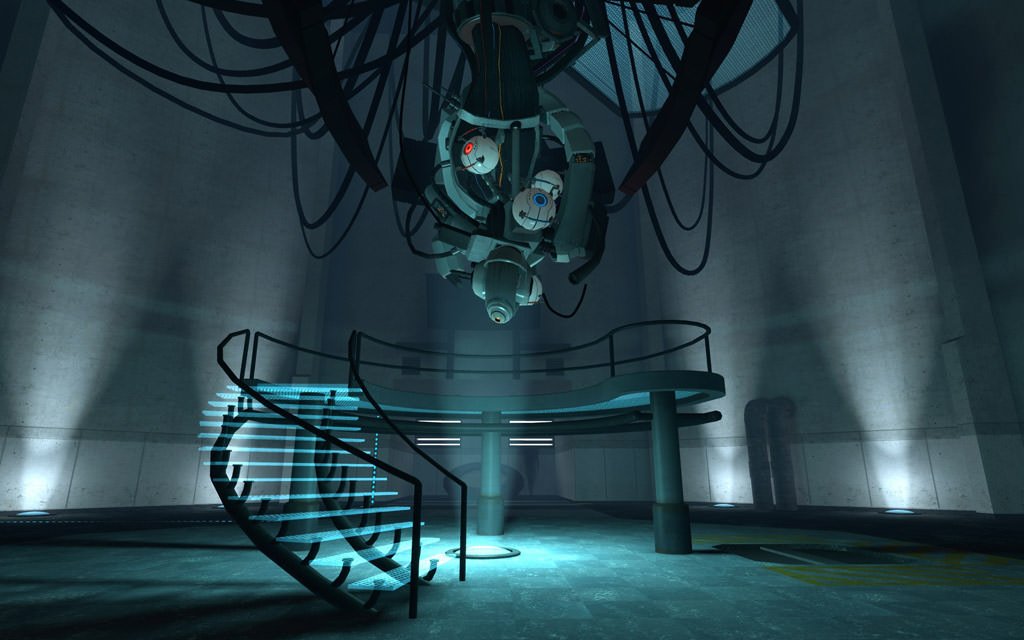
GLaDOS from Portal, voiced by Ellen McLain

Ellen McLain, most recently voicing the computer of the main robot from Pacific Rim, is most well known for her voice work in the Portal franchise. While McLain’s GLaDOS (Genetic Lifeform and Disk Operating System) from Portal may be one of the best-known AI/VI voices from video games, the line goes on. From the popular Halo series the AI Cortana (voiced by Jen Taylor) assists and informs the player, but also evolved to be more sexualized as the series and graphics allowed it to. From Mass Effect 2 and Mass Effect 3 there comes EDI (voiced by Tricia Helfer), a female voiced AI that chooses a provocative robotic female body to integrate with.  Going farther back, before the turn of the century, there was the intense computer SHODAN (voiced by Terri Brosius) from the System Shock series. Some of the most memorable computer programs from the last few generation of game consoles have been vocalized as feminine.

SHODAN from System Shock, voiced by Terri Brosius


Why is this?  With the recent backlash at the video game community for its lack of strong female characters, it is interesting to see that many of the ‘fake’ people or minds in video games are portrayed as or performed as female.  Artificial intelligences are not true people, but the prevalence to refer to GLaDOs as ‘she’ instead of ‘it’ remains.  These computers contain a mixture of stereotypically gendered traits, from the feminine gracefulness to the masculine lack of emotion. But these computer programs share a lot of traits with successful women in the workplace; they are effective, hard working, confident, knowledgeable, and self-reliant. Given this there is still, in most cases, no realistic middle ground; these AIs are either helpful, following orders as an artificial assistant, or they are cruel, manipulative and against the player character.

The evolution of Cortana's appearance.
Sadly, it seems that video games create more female voiced or bodied avatars when they make them out of metal instead of bone.  This trend is changing as reimagined classic female characters reemerge and new characters are created, but video games still have a long way to go in character equality. Fully-fledged female characters in video games are still hard to come by, but these exaggerated, objectified feminine computer programs are actually very well known and persistent.  Video games have a bad reputation of objectifying women and organizing female characters by tropes. While characters such as GLaDOS and SHODAN are loved, these AI characters are not doing video games any favors towards more realistic interpretations of women.  While these AIs may be viewed as intelligent women, some are sexualized without choice or representation. While Halo’s AI Cortana started off as blocky graphics back in 2001, her most recent rendition depicts her as a seductive and naked digitized woman. Mass Effect’s EDI implants her own consciousness into the empty robotic shell of a metal femme fatale.  It is noted throughout the game that EDI has chosen to inhabit an attractive form.  With their attractive bodies they are also mostly void of emotion but brimming with information and assistance.

The use of feminine-voiced computers has allowed video games and movies to give us some beloved characters, but there is a clear split between those that use it to represent a creation of intellect, or a creation meant to objectify the female form. It is interesting to note that the helpful female AIs are usually given attractive female forms, while those who are independent and usually malicious are abstract voices. 

As the realm of science fiction expands, computer graphics increase, and stories continue to be written, it will be interesting to see how the artificial and real women of video games and movies are represented. AI characters are a wonderful addition to science fiction and allow for great story expansion. Yet these artificial female representations do not create a pass for appropriate objectification, especially if the AI is the only slight version of female representation in the film or game.  When a high-budget summer release such as Pacific Rim can still fall short of the Bechdel test, and video games are still under fire for their lack of strong female characters, certain changes have already been called for. Adding to those, a change in the way mechanical humanoids are used, in some but not all cases, to exploit the female form and emphasize stereotypical feminine traits. 

Monday, June 10, 2013

The Art of the Fantastic

-->
I had the great luck to be able to attend Spectrum Fantastic Art Live 2 just a little while ago.  The drive to Kansas City, MO took far longer than I should have wished, but it was well worth it. The variety of great artists filling the gallery hall was a site I will remember in both my memory and my photo album. These are the paintings that inspire children to dream of dragons, for men and women to visualize as they read through books to escape their lives for a short time, these are the pieces that create a world beyond the real.  While my main objective for this trip was to enjoy the fantastic art I have loved since childhood and to have informative conversations with artist of a far better caliber than myself, I always have secondary objectives. 
Spectrum 20 Award Gala, Beautiful


Walking around the hall, rows of paintings, sketches, sculptures, and live demonstrations, it is easy to identify some of the classic depiction of sci-fi and fantasy women. Sadly, these classic depictions are most commonly that of the Damsel in Distress, the Evil Seductress, or the Power is Sex(y). There were rows upon rows of booths, but within those rows, hidden sometimes at the corners, these upsetting depictions of the women in sci-fi and fantasy were still alive. At one point I began to notice that some of the paintings, prints, and illustration that had more graphic sexual content were being censored with small slips of stick-notes. They were stuck on, hiding nipples or genitalia, while the rest of the picture was open for the viewing public. The picture of the chained woman with the distressed face and her legs spread, the exposed captured woman being taken off, the seductress enthralling onlookers with her sexual power, were all okay for viewing, all undamaging, as long as those few key pieces of anatomy were covered.  Seeing this it gave off a sad message: Viewing women as disempowered and objectified is fine, so long as that sticky-note stayed were it was stuck. I know this may have been for the sake of the children, since both artists and spectators were free to bring their children and some certainly did, but that does not really make the situations any better in my opinion. By blocking off those parts, but not the image it self, it may make it appropriate for public viewing, but it certainly does not decrease the impact it would have on how a boy views women or how a girl will choose to view herself.
I would like to clarify that I am not at all opposed to nudity in art. Nudity in art has existed since the beginning of art itself. The human body can convey power, grace, beauty, sexuality, environmental interaction, and the spectrum of human emotion.  David Palumdo's Fed is a great example of the power nudity can convey to an image. It is a disappointment when these such powerful works are overrun by the objectified and over-sexualized female figures so common in the sci-fi and fantasy world.  Again, though, similar to the argument about who has the power in what children see if video games, who has the power to change what is seen on book or comic covers?
Dan Dos Santos, a great artist I had the pleasure of meeting at SFAL2, was indirectly accused by a BBC article of being sexist in his works by using one of Dos Santos’ works as the example for sexist science fiction art.  The article goes on, giving other examples including the classic Conan depictions. The article brings up a few good points, such as how “many science fiction and fantasy readers are disappointed to encounter everyday sexism in a medium that is supposed to offer an escape” (which is similar to the immersion-problem many feel when playing video games).  It also points out that many science fiction covers, classic and modern, are still created to attract a heterosexual male audience, even though the amount of science fiction and fantasy female authors and readers, as well as members of the TGLBQ community, is on the rise.  One of the most powerful, and true, lines from the BBC article comes as a quote from Tracy Hurley:


"Male characters [are] powerful and strong, and women's sexuality will be emphasized. And why is that a problem? It's constraining for both men and women."

Art Hall, filled with fans, both men and women.
In response to this indirect critique, the artist collaboration blog Muddy Colors responded internally with a post by Arnie Fenner, retiring co-director of the long running Spectrum books that inspired/created the whole SFAL event.  Arnie brings up the key of the whole issue in his post Objectify:


“But unless I'm missing something, here's the thing that bugged me about the BBC article and Hines' cosplay: the artists get the "blame" for what appears on the books' covers. Not the writers whose stories and descriptions lend themselves to the interpretations being decried; not the publishers, not the editors, not the art directors, not the sales reps, not the retailers, and not the consumers. All of whom dictate what the commercial artist creates and delivers. If they don't approve, if the artist doesn't follow direction and give them what they're paying for, the art is never seen. If the customers don't buy the books, other solutions are sought.”


I agree, mostly. I agree that it takes a whole line of people from writer, to an art director, to an artist, to a publisher, to the consumer to create the sphere of influence in which these art pieces (both written and visual) can exist.  There is no easy solution. It is a whole cultural setting in which the realm of the idealized men and objectified women is written about, enforced, and portrayed. No individual or part of the chain of creation can be completely at fault, and blame cannot be so easily delegated.

            So, when a talented artist such as Dos Santos creates works such as the one critiqued by the BBC article, it took several stages for it to become that particular piece. The writer created the character, the art director gave input for the work, and the art was completed through the views of several people, not the artist alone. Also, to have called out an individual piece without these correct justifications was an obvious mistake. Sexist and objectified depictions, in video games, in comics, in the world of Fantastic art, do not exist in a vacuum and do not under the majority of circumstances come into the public view through the work of an individual.

            I’ve heard it said that in the art world that you have to take the jobs offered to you. To start off, you need all the money, work, and publicity you can get. Young artists, or artists just starting off, may find that falling in line with these constricted image types is the best way to begin a career, but this will only continue to perpetuate these images for years to come. Once set in their career, artist can choose to be picky. Steven Belledin, another artist I have had the great opportunity to meet, never compromises his values in his depiction of female characters.  He has said that this has at times put him at odds with those offering jobs, but I would like to assure him that for some viewers and new artists just knowing that not compromising is an option is a light for a better future. 

-K.

Monday, February 18, 2013

Sexualization of Men in Videogames

The sexualization of women characters in games has received attention from numerous sources over the years, including media, parents, and academics. However, Brathwaite, in Chapter 1 of Sex in Video Games, offered that women were not the only ones to be sexualized, but that in fact, several characters such as Duke Nukem and Kratos from God of War represent the sexualization of men.

"SEXXXY!"
This assertion confused me. I do not consider these characters to be hypersexualized, or even particularly sexualized. From my perspective, these characters are hypermasculinized. They may possess an over-the-top “idealized” body, but the player cannot, for example, move camera angles around to examine a character’s butt the way a player can for Lara Croft. In conversation H made a good point which is that many of these characters are not what a heterosexual woman would find sexy, but perhaps represent what a heterosexual man’s idea of what they think a heterosexual woman would find sexy. It is clear the the over-the-top “idealized” bodies of the male characters are for the benefit of the heterosexual men playing, much like the over-the-top “idealized” bodies of the female characters are for the benefit of the heterosexual men.

So I began to wonder, what would a (hyper-) sexualized man look like in a video game? J and I threw around a number of different ideas. Would a main man character who was dressed in a Chippendales outfit while everyone else was dressed normally count? How about one wearing a crop top and booty shorts? A revealing police uniform? But then we realized we were verging on The Village People territory. A character like the ones we described would be considered silly, not sexy, particularly to a heteronormative audience.

It is impossible to hypersexualize men the same way games hypersexualize women. This is because even if a man is sexualized, there is not a power dynamic which encourages players to view them solely as objects or possessions, like there is for women. Society does not allow for a man to be reduced to the sum of his body parts. There are no cultural narratives in the United States that contest a man’s place in a position of power or state that a man’s sole value lies in his biology, like there are for women.

- A.