Showing posts with label Female Depiction. Show all posts

Friday, August 2, 2013

Feminine Voice of Reason


Pacific Rim hit theaters just a little while back and made over thirty-seven million dollars during its opening weekend. It is an action-packed film, and for a movie about large robots fighting off hulking monsters, it has a surprising amount of story. If you haven’t heard already, Pacific Rim has a woman of color as a main character but, sadly, the film still does not pass the Bechdel Test. There is another female robot pilot, but she has almost no screen time and very few lines, and in the background only a few women can be picked out of the crowds of the main setting. But there is one familiar female voice that graces the screen, that of Ellen McLain as the voice of robot Gipsy Danger.

There has been a rise in the use of fictional computer voices, artificial intelligences, and virtual intelligences in recent years, accompanying the rise in science fiction’s popularity.  Voice actresses, such as Ellen McLain, portray voices that are mechanized, concise, educated, informative, and helpful. And it is almost always feminine. This can most prevalently be seen in the realm of video games, where science fiction and computer advancements have always been part of popular game design. For female-voiced AIs, video games and movies are their domain.
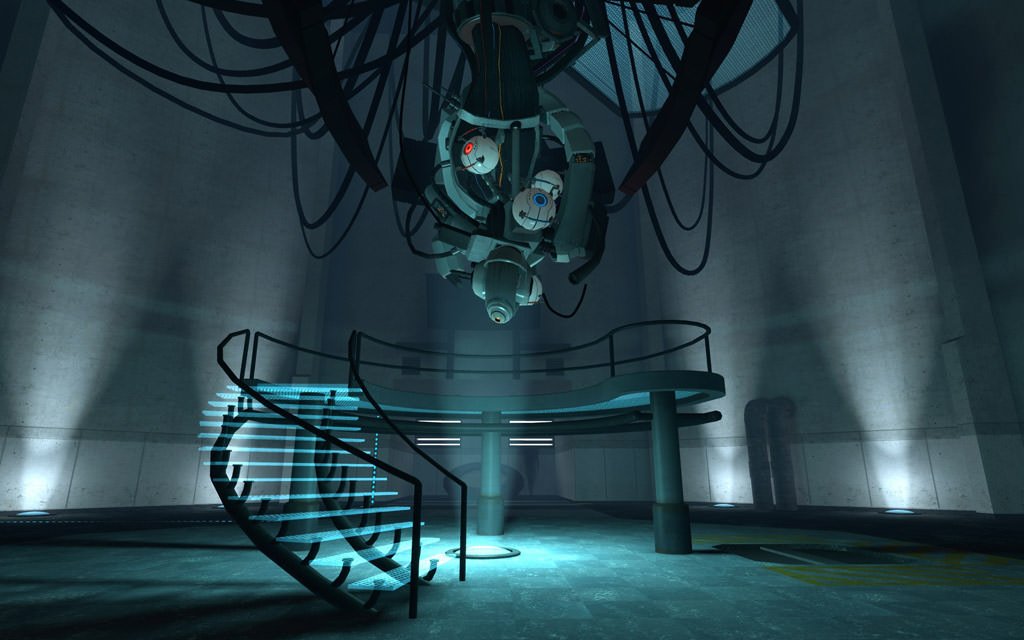
GLaDOS from Portal, voiced by Ellen McLain

Ellen McLain, most recently voicing the computer of the main robot from Pacific Rim, is most well known for her voice work in the Portal franchise. While McLain’s GLaDOS (Genetic Lifeform and Disk Operating System) from Portal may be one of the best-known AI/VI voices from video games, the line goes on. From the popular Halo series the AI Cortana (voiced by Jen Taylor) assists and informs the player, but also evolved to be more sexualized as the series and graphics allowed it to. From Mass Effect 2 and Mass Effect 3 there comes EDI (voiced by Tricia Helfer), a female voiced AI that chooses a provocative robotic female body to integrate with.  Going farther back, before the turn of the century, there was the intense computer SHODAN (voiced by Terri Brosius) from the System Shock series. Some of the most memorable computer programs from the last few generation of game consoles have been vocalized as feminine.

SHODAN from System Shock, voiced by Terri Brosius


Why is this?  With the recent backlash at the video game community for its lack of strong female characters, it is interesting to see that many of the ‘fake’ people or minds in video games are portrayed as or performed as female.  Artificial intelligences are not true people, but the prevalence to refer to GLaDOs as ‘she’ instead of ‘it’ remains.  These computers contain a mixture of stereotypically gendered traits, from the feminine gracefulness to the masculine lack of emotion. But these computer programs share a lot of traits with successful women in the workplace; they are effective, hard working, confident, knowledgeable, and self-reliant. Given this there is still, in most cases, no realistic middle ground; these AIs are either helpful, following orders as an artificial assistant, or they are cruel, manipulative and against the player character.

The evolution of Cortana's appearance.
Sadly, it seems that video games create more female voiced or bodied avatars when they make them out of metal instead of bone.  This trend is changing as reimagined classic female characters reemerge and new characters are created, but video games still have a long way to go in character equality. Fully-fledged female characters in video games are still hard to come by, but these exaggerated, objectified feminine computer programs are actually very well known and persistent.  Video games have a bad reputation of objectifying women and organizing female characters by tropes. While characters such as GLaDOS and SHODAN are loved, these AI characters are not doing video games any favors towards more realistic interpretations of women.  While these AIs may be viewed as intelligent women, some are sexualized without choice or representation. While Halo’s AI Cortana started off as blocky graphics back in 2001, her most recent rendition depicts her as a seductive and naked digitized woman. Mass Effect’s EDI implants her own consciousness into the empty robotic shell of a metal femme fatale.  It is noted throughout the game that EDI has chosen to inhabit an attractive form.  With their attractive bodies they are also mostly void of emotion but brimming with information and assistance.

The use of feminine-voiced computers has allowed video games and movies to give us some beloved characters, but there is a clear split between those that use it to represent a creation of intellect, or a creation meant to objectify the female form. It is interesting to note that the helpful female AIs are usually given attractive female forms, while those who are independent and usually malicious are abstract voices. 

As the realm of science fiction expands, computer graphics increase, and stories continue to be written, it will be interesting to see how the artificial and real women of video games and movies are represented. AI characters are a wonderful addition to science fiction and allow for great story expansion. Yet these artificial female representations do not create a pass for appropriate objectification, especially if the AI is the only slight version of female representation in the film or game.  When a high-budget summer release such as Pacific Rim can still fall short of the Bechdel test, and video games are still under fire for their lack of strong female characters, certain changes have already been called for. Adding to those, a change in the way mechanical humanoids are used, in some but not all cases, to exploit the female form and emphasize stereotypical feminine traits. 

Thursday, July 4, 2013

The Guide to Gaming Children


      The opportunity to play video games at a young age is a great step forward in educating children about technology and modern electronic interaction. Children of the technological age are growing up with skills that my parents are still taking time to learn. These skills will give gaming children a great boost towards understanding what will become their everyday world (not that I don’t support good old-fashioned stick fighting, tree climbing, and outdoor play).  Because video games can be so beneficial to these parts of a child’s life, as well as boosting imagination, motor skills and much more, it can be a great bonding activity for parents and their children.
      There are of course games that are made for children spanning all ages. There are games for infants, such as flash games that simulate peek-a-boo. There are those that follow popular children’s TV shows or movies, such as Disney’s many games.  Educational games, such as those that teach math or spelling, are made for classroom and at home use, but they are not the only manner in which video games can become educational.  There is a plethora of ways to make games not intentionally built for educational purposes educational.
Gaming Fun for All

A recent video by Extra Credits took on the topic of parents using games to the benefit of their children and the relationship they have with their children. Their examples prove that even games such as Grand Theft Auto or Call of Duty can open up a child’s mind to the greater issues that games discuss or are based around. It even brings up the ever-important idea of cross-media research and non-gaming interaction. One of the most beneficial things non-gaming parents can do to show interest in their child’s gaming hobby is to sit with them and attempt to assist them. Giving a child a game should not be a cop-out on parental interaction, especially if the child has a great interest in games.  It should be seen as an opportunity for bonding, an opportunity to become part of the child’s hobby.  It can be a great experience for both the parent and child.  A parent sitting down and fervently translating a cypher while their child breaks through an Assassin’s Creed II glyph can be just as engaging and supporting as attending a child’s soccer game.
      The example above also shows how a game can open up great avenues of conversation. Games like Assassin’s Creed II open up questions and conversations about geography, history, cryptography, realms of science fiction, and much more.  Almost every game can be broken down into ideas worth discussing. An educating game does not have to be an ‘educational game’. 
Gender: Sex: Trait: Role - Very little choice
      Cooperative games are also a great device in the family bonding tool-kit. For younger children, playing a game from the LEGO franchise with their parents will build teamwork skills and perhaps act as a trust building exercise. It is also important to think of the impact games have on a child’s idea of gender roles. Playing games like LittleBig Planet will not only let a child’s imagination run wild, but through creating there own little Sack-avatar they can play with what it means to make representation of themselves (or just a mustached cook with a purple afro), which is far less constricting than some older games (Harvest Moon 3’s, ‘Are you a boy or a girl?’).  It is important to sit down and discuss the gender stereotypes seen in most games, and then choose games with less constricting and more positive views on individual differences to counter the negative input.
      In some ways it is up to gaming parents to protect their children from some of the negative aspects of video games they are not yet prepared for, but it is also up to them to use video games as a positive, educational, and constructive tool.  The video game industry and these games’ influences are growing every year.  Rather than skip out on this opportunity due to the media through which it is presented, parents should look for ways to enhance their child’s gaming experience.


-K.


As an endnote, I should state that I am not a parent. But as a child who played video games I sometime had a great time playing with my parents and siblings. To this day my family still uses video games as entertainment and bonding during family visits. I am glad that my parents took the time to show interest, and that they continue to do so.

Monday, June 10, 2013

The Art of the Fantastic

-->
I had the great luck to be able to attend Spectrum Fantastic Art Live 2 just a little while ago.  The drive to Kansas City, MO took far longer than I should have wished, but it was well worth it. The variety of great artists filling the gallery hall was a site I will remember in both my memory and my photo album. These are the paintings that inspire children to dream of dragons, for men and women to visualize as they read through books to escape their lives for a short time, these are the pieces that create a world beyond the real.  While my main objective for this trip was to enjoy the fantastic art I have loved since childhood and to have informative conversations with artist of a far better caliber than myself, I always have secondary objectives. 
Spectrum 20 Award Gala, Beautiful


Walking around the hall, rows of paintings, sketches, sculptures, and live demonstrations, it is easy to identify some of the classic depiction of sci-fi and fantasy women. Sadly, these classic depictions are most commonly that of the Damsel in Distress, the Evil Seductress, or the Power is Sex(y). There were rows upon rows of booths, but within those rows, hidden sometimes at the corners, these upsetting depictions of the women in sci-fi and fantasy were still alive. At one point I began to notice that some of the paintings, prints, and illustration that had more graphic sexual content were being censored with small slips of stick-notes. They were stuck on, hiding nipples or genitalia, while the rest of the picture was open for the viewing public. The picture of the chained woman with the distressed face and her legs spread, the exposed captured woman being taken off, the seductress enthralling onlookers with her sexual power, were all okay for viewing, all undamaging, as long as those few key pieces of anatomy were covered.  Seeing this it gave off a sad message: Viewing women as disempowered and objectified is fine, so long as that sticky-note stayed were it was stuck. I know this may have been for the sake of the children, since both artists and spectators were free to bring their children and some certainly did, but that does not really make the situations any better in my opinion. By blocking off those parts, but not the image it self, it may make it appropriate for public viewing, but it certainly does not decrease the impact it would have on how a boy views women or how a girl will choose to view herself.
I would like to clarify that I am not at all opposed to nudity in art. Nudity in art has existed since the beginning of art itself. The human body can convey power, grace, beauty, sexuality, environmental interaction, and the spectrum of human emotion.  David Palumdo's Fed is a great example of the power nudity can convey to an image. It is a disappointment when these such powerful works are overrun by the objectified and over-sexualized female figures so common in the sci-fi and fantasy world.  Again, though, similar to the argument about who has the power in what children see if video games, who has the power to change what is seen on book or comic covers?
Dan Dos Santos, a great artist I had the pleasure of meeting at SFAL2, was indirectly accused by a BBC article of being sexist in his works by using one of Dos Santos’ works as the example for sexist science fiction art.  The article goes on, giving other examples including the classic Conan depictions. The article brings up a few good points, such as how “many science fiction and fantasy readers are disappointed to encounter everyday sexism in a medium that is supposed to offer an escape” (which is similar to the immersion-problem many feel when playing video games).  It also points out that many science fiction covers, classic and modern, are still created to attract a heterosexual male audience, even though the amount of science fiction and fantasy female authors and readers, as well as members of the TGLBQ community, is on the rise.  One of the most powerful, and true, lines from the BBC article comes as a quote from Tracy Hurley:


"Male characters [are] powerful and strong, and women's sexuality will be emphasized. And why is that a problem? It's constraining for both men and women."

Art Hall, filled with fans, both men and women.
In response to this indirect critique, the artist collaboration blog Muddy Colors responded internally with a post by Arnie Fenner, retiring co-director of the long running Spectrum books that inspired/created the whole SFAL event.  Arnie brings up the key of the whole issue in his post Objectify:


“But unless I'm missing something, here's the thing that bugged me about the BBC article and Hines' cosplay: the artists get the "blame" for what appears on the books' covers. Not the writers whose stories and descriptions lend themselves to the interpretations being decried; not the publishers, not the editors, not the art directors, not the sales reps, not the retailers, and not the consumers. All of whom dictate what the commercial artist creates and delivers. If they don't approve, if the artist doesn't follow direction and give them what they're paying for, the art is never seen. If the customers don't buy the books, other solutions are sought.”


I agree, mostly. I agree that it takes a whole line of people from writer, to an art director, to an artist, to a publisher, to the consumer to create the sphere of influence in which these art pieces (both written and visual) can exist.  There is no easy solution. It is a whole cultural setting in which the realm of the idealized men and objectified women is written about, enforced, and portrayed. No individual or part of the chain of creation can be completely at fault, and blame cannot be so easily delegated.

            So, when a talented artist such as Dos Santos creates works such as the one critiqued by the BBC article, it took several stages for it to become that particular piece. The writer created the character, the art director gave input for the work, and the art was completed through the views of several people, not the artist alone. Also, to have called out an individual piece without these correct justifications was an obvious mistake. Sexist and objectified depictions, in video games, in comics, in the world of Fantastic art, do not exist in a vacuum and do not under the majority of circumstances come into the public view through the work of an individual.

            I’ve heard it said that in the art world that you have to take the jobs offered to you. To start off, you need all the money, work, and publicity you can get. Young artists, or artists just starting off, may find that falling in line with these constricted image types is the best way to begin a career, but this will only continue to perpetuate these images for years to come. Once set in their career, artist can choose to be picky. Steven Belledin, another artist I have had the great opportunity to meet, never compromises his values in his depiction of female characters.  He has said that this has at times put him at odds with those offering jobs, but I would like to assure him that for some viewers and new artists just knowing that not compromising is an option is a light for a better future. 

-K.

Friday, April 12, 2013

Fake Geek Girls, Fake Geek Problems

It is difficult to have a valid discussion on a concept that is so hotly debated. The idea of the Fake Geek Girl exists in a multitude of discussions. Do they exist at all? Does the idea of a Fake Geek Girl have a spectrum? Is one a Fake Geek Girl to the complete exclusion of being an actual geek?  Does the debate of the Fake Geek Girl expand to booth babes, or even just a geek culture naïf? What stressors over the last few years of the geek and gaming community has led to the explosion of negative energy towards the communities female participants?  When the first postings about the Fake Geek Girl hit the Internet it ushered in a flood of reactions both condemning the idea and expanding upon it.

The Fake Geek Girl has a vague definition. Articles by CNN, The Atlantic, and Forbes (several times) contributors explain that FGGs are “pretty girls pretending to be geeks for attention”. One article even drew the FGG infiltration as parallel to the Communist sleeper agent uncertainty of the 1950s. Jokes are cracked and comics and advertisements are drawn about how these FGGs are here to prey on the male geeks as unfeeling huntresses. These comics or short films, while made in jest as a manner to dismiss the FGG, can actually get across some important points. One short film has a humorous depiction of the FGG as a murderer. In it, the detective makes a comment stating that: “Maybe there is no fake geek girl. Maybe it is just a product of the deeply rooted sexism of geek culture. Maybe she is just a manifestation of the insecurities about the opposite sex”.  This is the only somewhat serious part of the film, and it is quickly laughed off and forgotten. Yet, Dr. Andrea Letamendi, who writes for The Mary Sue, explains that this may be the case as well as several other factors.
Pulp Scifi style seems perfect for the silly idea.
Dr. Letamendi explains the situation on both sides: why the male geek population reacted to viciously, and why the female geek population reacted so defensively. She lays it out in three very clear lines. Geeks are afraid of imposters and false infiltrators because: 1) There is a false notion of limited resources within the community, 2) The community has a misinterpreted sense of ownership, and 3) There is resentment for the change that ‘geek’ culture is undergoing. These negative ideas are supported by the fact that, every once in a blue moon, there is a girl just looking to get some attention in a skimpy cosplay, there are still booth babes in many conventions, and fledgling geeks are not given enough positive reinforcement to pursue the culture before being turned away.

Dr. Letamendi also states that female ‘geeks’ become defensive at the idea of the FGG because of long-seated “insults, indignities, and demeaning messages from other members of the comics community”.  She brings up the subtle ways in which female members of the community are belittled, stating the use of microaggressions, to plant a disparaging seed in the female geek’s mind. She also elaborates on the ways women are made to feel invisible within the community, as well as pointing out that female geeks are constantly told that they cannot keep up intellectually with their male counterparts.


There may be a little more to it though.  The introduction of the idea of the FGG to the popular community mindset led to the creation of a new wall.  This barrier, arbitrary in its subject or depth, has to be hurdled every time a female geek wants to participate in the community’s conversations. Every time the wall is faced, the qualifications to be an ‘authentic geek’ changes. Many of the articles about FGGs written by females who consider themselves part of the community start their articles with their geek justifications; a list of how and why they can be considered part of the community. They have to prove themselves, establish their geek credentials, in fear of not being taken seriously.

The itching idea of attractive female non-geeks invading the geek-space for attention without an actual interest in the geek subset of cultural material has been growing for a while. Bans on the use of Booth Babes (another term for a promotional model), female models hired to attract attention to products and product tables at conventions, has been on the scene for a while.  But for them it is different, while they may be at the con for the attention, they are also there for the money, for them it is a job. But the main worry is that this condescending attitude towards ‘pretty invaders’ is now being applied to attractive female geek community members who have, for a long time, felt like a part of the community and are now faced with requests of justification.

-K.

Sunday, February 10, 2013

A Plea for More Monstrous Ladies

When discussing the treatment of women in gaming circles, I often come back to the designs of the characters themselves. I feel as though a lot of the sexist harassment experienced by players in game is often backed-up by the portrayals of the women characters in the game. In games where very few women even exist in the world, it may be simply under-representation that creates these tensions resulting in male players feeling like they are in a "boys only club". In games where women characters are rather prominent, however, representations take on more layers and complexities. Reading this blog post, I was especially struck by the reaction that this woman received when attempting to ask for more reasonable outfits for many of World of Warcraft's most prominent lore characters.

She has an excellent point, many of WoW's key characters are powerful women, including the Dragon Aspects. That being said their outfits are in many cases bikinis-- creating confusion when compared to their often heavily armored and certainly more covered male counterparts.

For some examples take a look at Alexstrasza, the Life-Bringer and leader of the Dragon Aspects compared to Kalecgos, the youngest Dragon Aspect. She's much more powerful than him-- in charge of life itself-- and yet her outfit appears to be right out of a Victoria's Secret catalog, as the woman at BlizzCon noted.

Dragon Aspects
Need more convincing? How about two Forsaken lore characters. Both are undead (zombies essentially). Sylvannas, the leader of the Forsaken and an extremely powerful character has the bikini on, while Putris, a male Forsaken gets an awesome mask and full body coverage plus bones showing, displaying that he is actually undead and frankly, creepy. An archer and leader with an exposed stomach? This just doesn't make a lot of sense.
Sylvanas and Putris
What ends up happening is that powerful and complex characters like Sylvannas are reduced to sexual objects. Sylvanas is downright diabolical. She has a tragic backstory. She controls a legion of undead forsaken, many of whom worship her. And yet, as many male players will comment in-game, she is just portrayed as sexy. This kind of representation, degrading even powerful women to sexual objects to be ogled, creates an environment where it is okay to call female players "sluts" and "bitches".

These representations extend into the playable race models for each gender. The sexual dimorphism between male and female models of the playable races is very apparent, and it is clear that the female variations must a) be clearly and without a doubt "female" and b) be sexy, with clear focus on thinness, breasts, and behinds.

The draenei and the worgen are good examples of this. Both are "monster" humanoids. The draenei are a race of aliens  and the worgen are werewolves, cursed with transformative powers. However, the female characters are less "monstrous" and more sexualized. The draenei women are clearly designed to fit a supermodel ideal and the lady worgen are a lot less menacing than their male counterparts. As a female player, I felt especially downtrodden when the worgen models were released. It seemed like the developers felt they had to try to balance "monster" with "clearly female/sexy" and the model that resulted was a disappointment-- particularly in comparison to the very menacing male.

Worgen
In addition to these tensions in design, there are only 3 or 4 humanoid mobs in the game (besides established playable race models) that are female. This means that there are almost no monstrous and dangerous ladies to kill as an adventurer in the World of Warcraft. Even the Naga, which have prominent female mobs, have clear sexual dimorphism favoring a "prettier" lady monster. (I mean, just compare the female and male faces!)
Naga Models
So what does this all mean? For one, these trends mean that WoW players aren't seeing powerful ladies that aren't bikini-clad or super-model pretty. Whether it's a playable character, a mob or a pivotal lore character, the females consistently stand out as being sexualized and made "pretty" even in a world torn by violence, war and adventure. This leaves female players with a sense that even in a virtual place where their heroism is needed, it is still very important-- if not most important-- that they are pretty, that they are sexy, and that they appeal to heterosexual male sensibilities. Not only does this focus re-enforce the media socialization that women and girls are constantly bombarded with, it allows male players to focus on these attributes of women as well. If the game developers see many women as merely sexual objects, why wouldn't the players immersed in that world feel justified in feeling the same? Ultimately video games are just another type of media and there is a clear focus on attractiveness in the most conventional sense. Being sexy isn't bad, but when sexiness is the focus and one of the only options, it sure is discouraging.

So lets have less focus on attractiveness. I want more monstrous ladies!

-H.