Showing posts with label Sex-Biased Design. Show all posts

Friday, August 2, 2013

Feminine Voice of Reason


Pacific Rim hit theaters just a little while back and made over thirty-seven million dollars during its opening weekend. It is an action-packed film, and for a movie about large robots fighting off hulking monsters, it has a surprising amount of story. If you haven’t heard already, Pacific Rim has a woman of color as a main character but, sadly, the film still does not pass the Bechdel Test. There is another female robot pilot, but she has almost no screen time and very few lines, and in the background only a few women can be picked out of the crowds of the main setting. But there is one familiar female voice that graces the screen, that of Ellen McLain as the voice of robot Gipsy Danger.

There has been a rise in the use of fictional computer voices, artificial intelligences, and virtual intelligences in recent years, accompanying the rise in science fiction’s popularity.  Voice actresses, such as Ellen McLain, portray voices that are mechanized, concise, educated, informative, and helpful. And it is almost always feminine. This can most prevalently be seen in the realm of video games, where science fiction and computer advancements have always been part of popular game design. For female-voiced AIs, video games and movies are their domain.
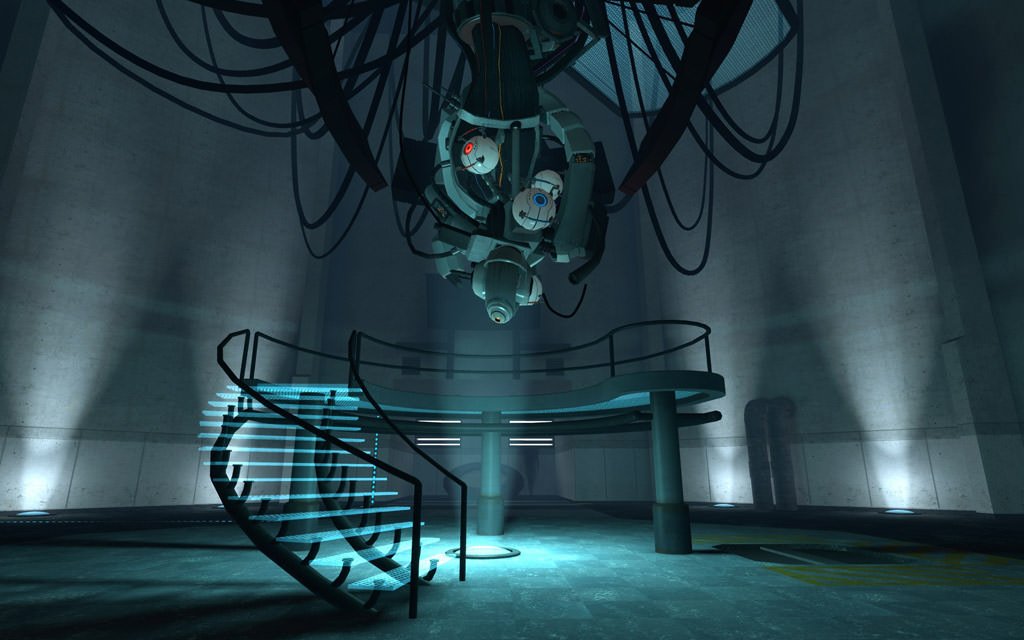
GLaDOS from Portal, voiced by Ellen McLain

Ellen McLain, most recently voicing the computer of the main robot from Pacific Rim, is most well known for her voice work in the Portal franchise. While McLain’s GLaDOS (Genetic Lifeform and Disk Operating System) from Portal may be one of the best-known AI/VI voices from video games, the line goes on. From the popular Halo series the AI Cortana (voiced by Jen Taylor) assists and informs the player, but also evolved to be more sexualized as the series and graphics allowed it to. From Mass Effect 2 and Mass Effect 3 there comes EDI (voiced by Tricia Helfer), a female voiced AI that chooses a provocative robotic female body to integrate with.  Going farther back, before the turn of the century, there was the intense computer SHODAN (voiced by Terri Brosius) from the System Shock series. Some of the most memorable computer programs from the last few generation of game consoles have been vocalized as feminine.

SHODAN from System Shock, voiced by Terri Brosius


Why is this?  With the recent backlash at the video game community for its lack of strong female characters, it is interesting to see that many of the ‘fake’ people or minds in video games are portrayed as or performed as female.  Artificial intelligences are not true people, but the prevalence to refer to GLaDOs as ‘she’ instead of ‘it’ remains.  These computers contain a mixture of stereotypically gendered traits, from the feminine gracefulness to the masculine lack of emotion. But these computer programs share a lot of traits with successful women in the workplace; they are effective, hard working, confident, knowledgeable, and self-reliant. Given this there is still, in most cases, no realistic middle ground; these AIs are either helpful, following orders as an artificial assistant, or they are cruel, manipulative and against the player character.

The evolution of Cortana's appearance.
Sadly, it seems that video games create more female voiced or bodied avatars when they make them out of metal instead of bone.  This trend is changing as reimagined classic female characters reemerge and new characters are created, but video games still have a long way to go in character equality. Fully-fledged female characters in video games are still hard to come by, but these exaggerated, objectified feminine computer programs are actually very well known and persistent.  Video games have a bad reputation of objectifying women and organizing female characters by tropes. While characters such as GLaDOS and SHODAN are loved, these AI characters are not doing video games any favors towards more realistic interpretations of women.  While these AIs may be viewed as intelligent women, some are sexualized without choice or representation. While Halo’s AI Cortana started off as blocky graphics back in 2001, her most recent rendition depicts her as a seductive and naked digitized woman. Mass Effect’s EDI implants her own consciousness into the empty robotic shell of a metal femme fatale.  It is noted throughout the game that EDI has chosen to inhabit an attractive form.  With their attractive bodies they are also mostly void of emotion but brimming with information and assistance.

The use of feminine-voiced computers has allowed video games and movies to give us some beloved characters, but there is a clear split between those that use it to represent a creation of intellect, or a creation meant to objectify the female form. It is interesting to note that the helpful female AIs are usually given attractive female forms, while those who are independent and usually malicious are abstract voices. 

As the realm of science fiction expands, computer graphics increase, and stories continue to be written, it will be interesting to see how the artificial and real women of video games and movies are represented. AI characters are a wonderful addition to science fiction and allow for great story expansion. Yet these artificial female representations do not create a pass for appropriate objectification, especially if the AI is the only slight version of female representation in the film or game.  When a high-budget summer release such as Pacific Rim can still fall short of the Bechdel test, and video games are still under fire for their lack of strong female characters, certain changes have already been called for. Adding to those, a change in the way mechanical humanoids are used, in some but not all cases, to exploit the female form and emphasize stereotypical feminine traits. 

Monday, February 18, 2013

Sexualization of Men in Videogames

The sexualization of women characters in games has received attention from numerous sources over the years, including media, parents, and academics. However, Brathwaite, in Chapter 1 of Sex in Video Games, offered that women were not the only ones to be sexualized, but that in fact, several characters such as Duke Nukem and Kratos from God of War represent the sexualization of men.

"SEXXXY!"
This assertion confused me. I do not consider these characters to be hypersexualized, or even particularly sexualized. From my perspective, these characters are hypermasculinized. They may possess an over-the-top “idealized” body, but the player cannot, for example, move camera angles around to examine a character’s butt the way a player can for Lara Croft. In conversation H made a good point which is that many of these characters are not what a heterosexual woman would find sexy, but perhaps represent what a heterosexual man’s idea of what they think a heterosexual woman would find sexy. It is clear the the over-the-top “idealized” bodies of the male characters are for the benefit of the heterosexual men playing, much like the over-the-top “idealized” bodies of the female characters are for the benefit of the heterosexual men.

So I began to wonder, what would a (hyper-) sexualized man look like in a video game? J and I threw around a number of different ideas. Would a main man character who was dressed in a Chippendales outfit while everyone else was dressed normally count? How about one wearing a crop top and booty shorts? A revealing police uniform? But then we realized we were verging on The Village People territory. A character like the ones we described would be considered silly, not sexy, particularly to a heteronormative audience.

It is impossible to hypersexualize men the same way games hypersexualize women. This is because even if a man is sexualized, there is not a power dynamic which encourages players to view them solely as objects or possessions, like there is for women. Society does not allow for a man to be reduced to the sum of his body parts. There are no cultural narratives in the United States that contest a man’s place in a position of power or state that a man’s sole value lies in his biology, like there are for women.

- A.

Sunday, February 10, 2013

A Plea for More Monstrous Ladies

When discussing the treatment of women in gaming circles, I often come back to the designs of the characters themselves. I feel as though a lot of the sexist harassment experienced by players in game is often backed-up by the portrayals of the women characters in the game. In games where very few women even exist in the world, it may be simply under-representation that creates these tensions resulting in male players feeling like they are in a "boys only club". In games where women characters are rather prominent, however, representations take on more layers and complexities. Reading this blog post, I was especially struck by the reaction that this woman received when attempting to ask for more reasonable outfits for many of World of Warcraft's most prominent lore characters.

She has an excellent point, many of WoW's key characters are powerful women, including the Dragon Aspects. That being said their outfits are in many cases bikinis-- creating confusion when compared to their often heavily armored and certainly more covered male counterparts.

For some examples take a look at Alexstrasza, the Life-Bringer and leader of the Dragon Aspects compared to Kalecgos, the youngest Dragon Aspect. She's much more powerful than him-- in charge of life itself-- and yet her outfit appears to be right out of a Victoria's Secret catalog, as the woman at BlizzCon noted.

Dragon Aspects
Need more convincing? How about two Forsaken lore characters. Both are undead (zombies essentially). Sylvannas, the leader of the Forsaken and an extremely powerful character has the bikini on, while Putris, a male Forsaken gets an awesome mask and full body coverage plus bones showing, displaying that he is actually undead and frankly, creepy. An archer and leader with an exposed stomach? This just doesn't make a lot of sense.
Sylvanas and Putris
What ends up happening is that powerful and complex characters like Sylvannas are reduced to sexual objects. Sylvanas is downright diabolical. She has a tragic backstory. She controls a legion of undead forsaken, many of whom worship her. And yet, as many male players will comment in-game, she is just portrayed as sexy. This kind of representation, degrading even powerful women to sexual objects to be ogled, creates an environment where it is okay to call female players "sluts" and "bitches".

These representations extend into the playable race models for each gender. The sexual dimorphism between male and female models of the playable races is very apparent, and it is clear that the female variations must a) be clearly and without a doubt "female" and b) be sexy, with clear focus on thinness, breasts, and behinds.

The draenei and the worgen are good examples of this. Both are "monster" humanoids. The draenei are a race of aliens  and the worgen are werewolves, cursed with transformative powers. However, the female characters are less "monstrous" and more sexualized. The draenei women are clearly designed to fit a supermodel ideal and the lady worgen are a lot less menacing than their male counterparts. As a female player, I felt especially downtrodden when the worgen models were released. It seemed like the developers felt they had to try to balance "monster" with "clearly female/sexy" and the model that resulted was a disappointment-- particularly in comparison to the very menacing male.

Worgen
In addition to these tensions in design, there are only 3 or 4 humanoid mobs in the game (besides established playable race models) that are female. This means that there are almost no monstrous and dangerous ladies to kill as an adventurer in the World of Warcraft. Even the Naga, which have prominent female mobs, have clear sexual dimorphism favoring a "prettier" lady monster. (I mean, just compare the female and male faces!)
Naga Models
So what does this all mean? For one, these trends mean that WoW players aren't seeing powerful ladies that aren't bikini-clad or super-model pretty. Whether it's a playable character, a mob or a pivotal lore character, the females consistently stand out as being sexualized and made "pretty" even in a world torn by violence, war and adventure. This leaves female players with a sense that even in a virtual place where their heroism is needed, it is still very important-- if not most important-- that they are pretty, that they are sexy, and that they appeal to heterosexual male sensibilities. Not only does this focus re-enforce the media socialization that women and girls are constantly bombarded with, it allows male players to focus on these attributes of women as well. If the game developers see many women as merely sexual objects, why wouldn't the players immersed in that world feel justified in feeling the same? Ultimately video games are just another type of media and there is a clear focus on attractiveness in the most conventional sense. Being sexy isn't bad, but when sexiness is the focus and one of the only options, it sure is discouraging.

So lets have less focus on attractiveness. I want more monstrous ladies!

-H.