Showing posts with label Representation. Show all posts

Friday, August 2, 2013

Feminine Voice of Reason


Pacific Rim hit theaters just a little while back and made over thirty-seven million dollars during its opening weekend. It is an action-packed film, and for a movie about large robots fighting off hulking monsters, it has a surprising amount of story. If you haven’t heard already, Pacific Rim has a woman of color as a main character but, sadly, the film still does not pass the Bechdel Test. There is another female robot pilot, but she has almost no screen time and very few lines, and in the background only a few women can be picked out of the crowds of the main setting. But there is one familiar female voice that graces the screen, that of Ellen McLain as the voice of robot Gipsy Danger.

There has been a rise in the use of fictional computer voices, artificial intelligences, and virtual intelligences in recent years, accompanying the rise in science fiction’s popularity.  Voice actresses, such as Ellen McLain, portray voices that are mechanized, concise, educated, informative, and helpful. And it is almost always feminine. This can most prevalently be seen in the realm of video games, where science fiction and computer advancements have always been part of popular game design. For female-voiced AIs, video games and movies are their domain.
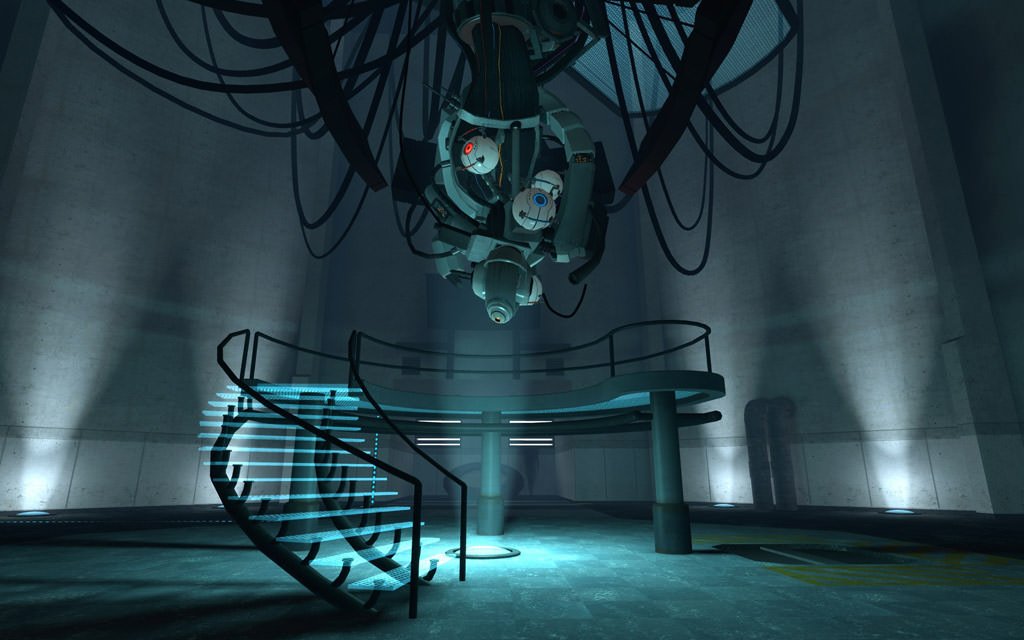
GLaDOS from Portal, voiced by Ellen McLain

Ellen McLain, most recently voicing the computer of the main robot from Pacific Rim, is most well known for her voice work in the Portal franchise. While McLain’s GLaDOS (Genetic Lifeform and Disk Operating System) from Portal may be one of the best-known AI/VI voices from video games, the line goes on. From the popular Halo series the AI Cortana (voiced by Jen Taylor) assists and informs the player, but also evolved to be more sexualized as the series and graphics allowed it to. From Mass Effect 2 and Mass Effect 3 there comes EDI (voiced by Tricia Helfer), a female voiced AI that chooses a provocative robotic female body to integrate with.  Going farther back, before the turn of the century, there was the intense computer SHODAN (voiced by Terri Brosius) from the System Shock series. Some of the most memorable computer programs from the last few generation of game consoles have been vocalized as feminine.

SHODAN from System Shock, voiced by Terri Brosius


Why is this?  With the recent backlash at the video game community for its lack of strong female characters, it is interesting to see that many of the ‘fake’ people or minds in video games are portrayed as or performed as female.  Artificial intelligences are not true people, but the prevalence to refer to GLaDOs as ‘she’ instead of ‘it’ remains.  These computers contain a mixture of stereotypically gendered traits, from the feminine gracefulness to the masculine lack of emotion. But these computer programs share a lot of traits with successful women in the workplace; they are effective, hard working, confident, knowledgeable, and self-reliant. Given this there is still, in most cases, no realistic middle ground; these AIs are either helpful, following orders as an artificial assistant, or they are cruel, manipulative and against the player character.

The evolution of Cortana's appearance.
Sadly, it seems that video games create more female voiced or bodied avatars when they make them out of metal instead of bone.  This trend is changing as reimagined classic female characters reemerge and new characters are created, but video games still have a long way to go in character equality. Fully-fledged female characters in video games are still hard to come by, but these exaggerated, objectified feminine computer programs are actually very well known and persistent.  Video games have a bad reputation of objectifying women and organizing female characters by tropes. While characters such as GLaDOS and SHODAN are loved, these AI characters are not doing video games any favors towards more realistic interpretations of women.  While these AIs may be viewed as intelligent women, some are sexualized without choice or representation. While Halo’s AI Cortana started off as blocky graphics back in 2001, her most recent rendition depicts her as a seductive and naked digitized woman. Mass Effect’s EDI implants her own consciousness into the empty robotic shell of a metal femme fatale.  It is noted throughout the game that EDI has chosen to inhabit an attractive form.  With their attractive bodies they are also mostly void of emotion but brimming with information and assistance.

The use of feminine-voiced computers has allowed video games and movies to give us some beloved characters, but there is a clear split between those that use it to represent a creation of intellect, or a creation meant to objectify the female form. It is interesting to note that the helpful female AIs are usually given attractive female forms, while those who are independent and usually malicious are abstract voices. 

As the realm of science fiction expands, computer graphics increase, and stories continue to be written, it will be interesting to see how the artificial and real women of video games and movies are represented. AI characters are a wonderful addition to science fiction and allow for great story expansion. Yet these artificial female representations do not create a pass for appropriate objectification, especially if the AI is the only slight version of female representation in the film or game.  When a high-budget summer release such as Pacific Rim can still fall short of the Bechdel test, and video games are still under fire for their lack of strong female characters, certain changes have already been called for. Adding to those, a change in the way mechanical humanoids are used, in some but not all cases, to exploit the female form and emphasize stereotypical feminine traits. 

Tuesday, June 25, 2013

What’s All the Hullabaloo About?


Earlier on this blog we may have touched on the recent Tropes Vs. Women in Video Games  controversy, and while I don’t believe we contributed a full post to it, it felt as though everything that had to be said had been said.  Now that the first two sections, both touching on the Damsels in Distress trope, have been posted and the internet has responded in its total manner of chaos blended with intellect, the truth is really there. Is this really the product that every mean-hearted, trolling, and down-right horrible post was scared of? And, yes, in my opinion they were scared. They were scared that this project would somehow damage or break the walls of the gaming community, the ‘gamer’ identity, and the realm of gaming that has for so long presented itself as being open.
But, as discussed on a previous post about the 'Gamer' identity, the ‘Gamer’ label is in itself exclusionary, and the realm of gaming does have walls.  Did these trolls and harassers think that the walls they spend so much time building and reinforcing were going to be so easily broken by one web series about women in video games? I could only hope. But no, those walls are strong, and the exclusionary, predominantly white heterosexual male girders holding them up are not easily taken down. 
Anita Sarkeesian’s first two released videos are tame, very much so. These videos brim information, with detailed research into the history of the Damsel in Distress, the history of video games, variety of the trope, a multitude of both modern and more classic games, and how the Damsel in Distress trope was transferred over to video games from earlier media.  Anita appears to have taken great care in ensuring that her videos can reach a wide audience.  While I am sure that she is fully capable of in-depth feminist discussion with the appropriate jargon, she presents herself and the information in a wide-reaching manner.  This allows for an open audience and open discussion between its viewers. 
This makes it even less threatening in some ways, and more in others. The videos are clear, concise, and intellectual and can be understood by all. Those trolling harassers can see her side of the argument in full, plain view and they can no longer fear that it will be feminist jargon, going over their heads on purpose to alienate them from what is attacking them.  There is no alienation, the video is all access. So, this is less frightening. But then comes the more frightening.
Because everything is so clear Anita can get her points and her research across quickly and efficiently. And for viewers like myself, it is a frighteningly large amount of information on just one of the several tropes she will be exploring in her series.  The pure amount of information, of games that conform to these tropes, is overwhelming. As a female gamer I now spend a portion of time examining games as I play and enjoy them. But I did not do so when I was younger or until just a few years ago.  Just the massive amount of games I have played that were on her list upset me (For the list, please visit this link for the Damsel in Distress Video).  
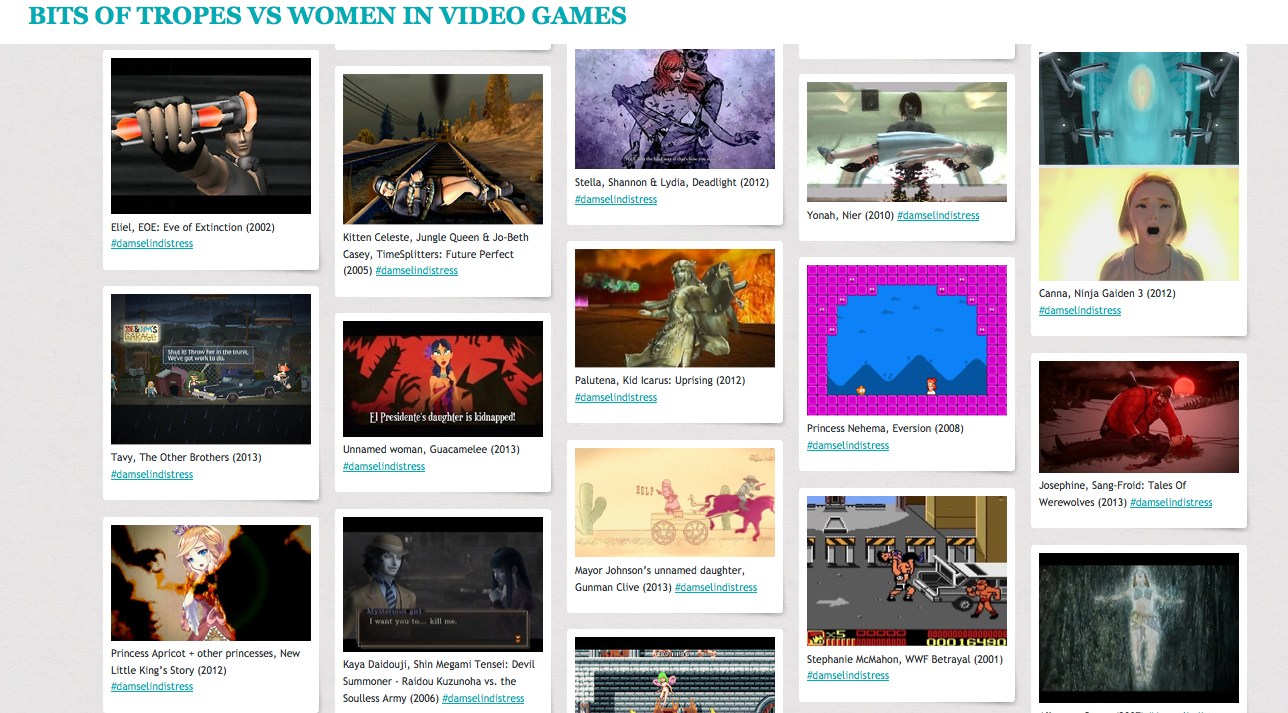
Check out all the example of a Damsel in Distress over at the Tropes vs. Women in Videos Games Tumblr.

The trope of Damsel in Distress not only permeates a large number of games, but it does so in such varying manners as to have subsets.  She examines these subsets not only in how they change gaming, but how they effect and have been effected by additional types of media. And it is so common. These tropes are being used to pump out low quality games with poor storytelling just to force feed the gamer mind. A Forbes contributor, Jen Bosier, said it just as I wanted to, “This isn’t just demeaning to women, it’s demeaning to gamers in general”.
            I want better games, for everyone. And that means creating in-depth stories that are not demeaning for the ever-expanding gaming community. These videos should in some small amount be feared, they are airing out the video games community’s closet and showing the world that, yes, things do need to change. 

-K.

Sunday, April 28, 2013

I Didn’t Hear You Correctly, Did I?

    While this article may not be within the realm of video games, I would still like to take time to comment on comics when I feel the need arises.  It is important to note that comics are another section of the ‘geek’ subculture to which games are also bound. Also, as I refer here to those characters existing within the Batman/Gotham DC Universe, it is important to know that just like this franchise, comics and games have had a border-crossing relationship for years.

    A while back I began reading the Gotham City Sirens, I got the whole set after enjoying the first few and I have been slowly working my way through them since.  After a group discussion about the interesting article by Rebecca Demarest, ‘Superheroes, Superpowers, and Sexuality’ I decided to take another look at the first issue.
Gotham City Sirens #1 - All in the Title, Isn't It?
To set the base for this discussion, I would like to first note on an interesting point put forth by Demarest. The concept of Inherent vs. Gifted Powers in the realm of comics is interesting and diverse, leading to a bounty of beloved or disputed origin stories.  She states “the women heroes are rarely ones to have inborn powers; they are usually gifted to them” while “the men on the other hand have inherent powers”. This is obviously not the case for every female or every male (an example being the X-Men), but it leans towards truth for the majority. Issue #1 of Gotham City Sirens begins with a narrative by Catwoman, so I will first attempt to elaborate on this anti-hero.

    Catwoman has a developing origin story. She was a prostitute who broke free from her old life.  In some she is a mafia boss’ daughter, and in others she is the daughter of a drunk. In Demarest’s understanding of Catwoman’s origins, “Catwoman’s…skills were taught to her by a karate sensei and a boxer, both of whom she was introduced to by a third party. She worked her butt off during her training, but it was still an integral part of the story that she did not get to where she was by herself, she had help”.  In this way, or even if looking at Catwoman as a product of Mama Fortuna’s training, Catwoman’s abilities are ‘gifted’ to her.
Poison Ivy- Just Out for a Jaunt

Poison Ivy, a villaness and eco-terrorist of the DC Universe, is one of the Siren trio.  For this series she has thrown off most of her criminal activities, and at points even treads along the line of anti-hero. Her powers are certainly ‘gifted’.  In both her modern and Silver Age origin stories she is injected with a serum/poison by another person (maliciously). It is this ‘gifted’ serum that gives her the abilities she posses as a villainess. (It should also be noted that in the modern origin story, the serum also makes her unable to bare a child.)

    Last, but never least, is Harley Quinn. At one point in Harleen’s life she was a prominent young physiatrist working a difficult but prestigious job at Arkham, but sessions with the Joker twist her into a gag-hammer toting, laughing lackey.  It is only through her ‘awakening’ by the Joker that she has initiative to take to villainy. Through her origins, she is the definition of a Barnacle character and while she already possessed the physical attributes to act, it is only through Jokers ‘gift’ of initiative that she steps onto the villain stage.

Harley Quinn - Poor Girl

    So, for these women, within the Batman/Gotham DC Universe, they fit the majority of the ‘gifted’ powered women. Demarest, calling on a contributor from the book Cultural Anthropology: A Problem-Based Approach, in this case Robbins, recalls ideas from linguist Robin Lakoff, stating that Lakoff “was one of the first to draw attention to the way that a woman’s identity in society influences how she speaks” and Lakoff says that women are “constrained to minimize their expressions with…tag questions…rising intonations…the use of hedges…[and] indirection”  (Robbins 2006: 205). It is this sort of language I examine Gotham City Sirens #1 for.

    While the appearance of this super-trio certainly falls into the stereotypical skimpy outfit and attractive figure, I am relieved to find that their speech patterns do not. Catwoman, while introduced as weak due to a recent injury, uses very assertive and sarcastic phrasing, similar to many primary young male supers.  She makes clear statements, and her use of questions is not meant to minimize her assertive statements. Poison Ivy has similarly assertive speech, with a slightly more sexualized overtone due to her inherent appeal based abilities. Harley Quinn, portrayed as childlike and still love struck, speaks mainly through the use of questions, tag questions, and assumed rising annotations, being the main fall-gal for the ‘feminine’ speech patterns.

    I believe that the reason behind the strong use of language by two of the main characters in Gotham City Sirens #1 is due to the need for strong central characters within the main cast. Having two strong voices can and will lead to interesting conflict, and the edition of a less assertive voice allows for comparison as well as the creation of dependent and engaging speech.

    There are many other facets of Demarest’s discussion of the difference between male and female supers in comics, including relationships and appearance, and the article is well worth a read for those interesting in the topic.  There is also an ongoing column over at Comics Bulletin discussing differing takes on DC’s gender issues that is well worth a read.  In the future I may examine some of DC’s New 52 for these patterns, although I know already that the New 52 has made a few mistakes with its female supers.

-K.

Thursday, April 25, 2013

On the Margins - Visual Novel Games


Cinders: A thoughtful visual novel game by MoaCube.
After reading “What Games Made By Girls Can Tell Us” by Jill Denner and Shannon Campe, I started thinking about games I’ve played that have similar qualities to the games the girls in the Girls Creating Games (GCG) program came up with. The girls were limited to a choose-your-own-adventure type game that relied on text and still images. While there was a lot of variation among the games they made they generally took place in realistic settings, focused on fears and social issues that girls face, had multiple endings, chances to win (but not necessarily at the expense of others), and a chance to pick the gender of your character.

Cinders (2012) a PC game developed and published by MoaCube, a small collective of indie game developers, is a visual novel game and retelling of the fairytale Cinderella. Displeased with the Cinderella story most people are familiar with (aka the Disney version), MoaCube set out to create a story where the protagonist, Cinders, plays an active role and the player feels like they are in control of the story. The story starts out familiar with Cinders at home with her “evil” stepsisters and stepmother but it doesn’t take long for the story to take unexpected twists and turns. The story is delivered through text dialogue and the player, when prompted, can choose what actions Cinders takes. Different decisions shape Cinders’s personality and can lead to four different endings with variations within each of them. More importantly, the decisions you make have enormous weight. I often found myself sitting at my computer, mulling over the options, worried that I’d make the wrong choice.

Similar to the GCG games, players are confronted with social issues such as deciding to disobey an authority figure, taking up a romantic interest (or not, the option is there), and navigating the strained relationship between Cinders and her stepsisters. Many games reinforce traditional gender roles, but Cinders allows you to experiment and find the path that best fits you.

Decision Time: What will you do?
Overall, Cinders is a high quality game with great characters, story, art, and music. I believe that there’s a huge market for visual novel games but as of now, they don’t get much press for the same reason that games “for girls” (like Imagine: Fashion Designer) don’t get attention within gamer culture. Their feminine elements and nontraditional style make people question whether or not they’re real games. Does Cinders count as a game when all you have to do is click through dialogue and make decisions? Is it just a visual novel or a visual novel game? I believe it’s as much a game as Halo or Dragon Age. Sure, the presentation is different but you’re still making decisions and roleplaying a character. Leaving visual novels out of the category of game just limits the medium and those who would potentially enjoy them. There’s a lot to like about visual novel games, and I have a feeling that in the future they’ll be a massive part of the casual/mobile game market.
- J.

Sunday, March 3, 2013

Representation Matters

In “Doing Gender in Cyberspace: The Performance of Gender by Female World of Warcraft Players” (2011), Lina Eklund examines how gender and sexuality are constructed within the MMORPG World of Warcraft. She found that while female players have agency to explore their gender and sexual identities, they are limited by societal gender expectations and the constraints of the game itself. “The heterosexual matrix sets norms that limit possible sexual expressions and firmly positions gender into the binary system of the heterosexual” (2011:336). World of Warcraft was not made in a cultural vacuum. The developers imposed their gender ideals upon the game world. Heterosexuality is assumed, males are masculine, and females are feminine. But what if there was a game that did not make these assumptions?
Arkh prominently features people of color.
Enter Arkh, a planned single player action-RPG designed around subverting the usually unquestioned character assumptions made in games. Tired of seeing the same white, male, hyper masculine characters, the developers of Arkh set out to create a game where the main cast primarily consists of queer people and people of color. As much as I’d like to say that this isn’t revolutionary, it is. Few games have characters of color, let alone characters that openly identify as anything other than heterosexual.

In Arkh you take on the role of a deity who has become bored with life amongst the gods. Your character, Aina, leaves paradise to find purpose in life and find their lost love. Gameplay focuses on the idea of reincarnation. As you are reincarnated into different worlds your deity changes appearance and you, the player, experience what its like to live through the lives of a variety of people. Aina’s gender identity is not set in stone and changes as you progress through different worlds. One of the developers explained, “In the story, what Ain will be called depends on who is talking to them, much like real life.” This change in identity is indicated by pronoun usage. Various non-player characters will refer to Aina as “he”, “she”, or “they” depending on Aina’s physical presentation. When talking about the character in general, however, the developers go with “they”.

While the game is still in the works and rumors are floating around that it will never be completed, the initial response to the game’s concept was positively received. Here are a few comments:

“I'm extremely glad that there is a game in development that defies the gaming norms. As an avid gamer myself (mostly of jrpgs because I like getting involved in the story), I'm very excited for this game to come out. As a queer person, I'm glad that I'm finally getting some representation in games!”

“Okay so I am pretty sure you get asks like this all the time. But I wanted to let you know that your project really puts a smile on my face and makes me excited for the future of videogames. As a supernerd an African American woman and a member of the LGBT community, I get so excited when I see characters like me in comics and videogames. I can't wait to see more from this project, and I really hope to support you in every way that I can.”

“Whooaaa This is like the best thing ever really can't wait for this to come out I'll anticipate every single update you have.”

“As someone who's genderqueer and pansexual, I have nearly cried in joy several times while reading through this story. Anytime you get a queer character in a game, they're always the same, token character. So thank you, so much, for this game. I want to hug each and every person working on this! :')”

“Putting aside how awesome it is that you're making a game for POC and the GLBT community, I think it's great that your female characters wear real armor.”
Aina and Haruka, two character concepts from Arkh.
Many non-gamers who identify as persons of color or queer who have never played a videogame in their life, were ecstatic about Arkh. Even though they aren’t familiar with the medium, they were excited by the mere plans to have a diverse group of people represented in the game. They were excited about having character they could relate to on a personal level and who looked like them. Once again, it seems like a small thing. But the fact remains

that videogames are dominated by the same white, male types. These games are a reflection of the mostly white, male industry they were created by. An entire population of people who were never interested in games before reconsidered once Arkh was announced. This illustrates the power of representation. I think that this instance could be applied to games in general. For example, if women were better represented in mainstream, big budget games perhaps they would be more likely to play them. If you’re more of the pragmatic type, the untapped market potential is huge.

- J.