Showing posts with label Harassment. Show all posts

Tuesday, June 25, 2013

What’s All the Hullabaloo About?


Earlier on this blog we may have touched on the recent Tropes Vs. Women in Video Games  controversy, and while I don’t believe we contributed a full post to it, it felt as though everything that had to be said had been said.  Now that the first two sections, both touching on the Damsels in Distress trope, have been posted and the internet has responded in its total manner of chaos blended with intellect, the truth is really there. Is this really the product that every mean-hearted, trolling, and down-right horrible post was scared of? And, yes, in my opinion they were scared. They were scared that this project would somehow damage or break the walls of the gaming community, the ‘gamer’ identity, and the realm of gaming that has for so long presented itself as being open.
But, as discussed on a previous post about the 'Gamer' identity, the ‘Gamer’ label is in itself exclusionary, and the realm of gaming does have walls.  Did these trolls and harassers think that the walls they spend so much time building and reinforcing were going to be so easily broken by one web series about women in video games? I could only hope. But no, those walls are strong, and the exclusionary, predominantly white heterosexual male girders holding them up are not easily taken down. 
Anita Sarkeesian’s first two released videos are tame, very much so. These videos brim information, with detailed research into the history of the Damsel in Distress, the history of video games, variety of the trope, a multitude of both modern and more classic games, and how the Damsel in Distress trope was transferred over to video games from earlier media.  Anita appears to have taken great care in ensuring that her videos can reach a wide audience.  While I am sure that she is fully capable of in-depth feminist discussion with the appropriate jargon, she presents herself and the information in a wide-reaching manner.  This allows for an open audience and open discussion between its viewers. 
This makes it even less threatening in some ways, and more in others. The videos are clear, concise, and intellectual and can be understood by all. Those trolling harassers can see her side of the argument in full, plain view and they can no longer fear that it will be feminist jargon, going over their heads on purpose to alienate them from what is attacking them.  There is no alienation, the video is all access. So, this is less frightening. But then comes the more frightening.
Because everything is so clear Anita can get her points and her research across quickly and efficiently. And for viewers like myself, it is a frighteningly large amount of information on just one of the several tropes she will be exploring in her series.  The pure amount of information, of games that conform to these tropes, is overwhelming. As a female gamer I now spend a portion of time examining games as I play and enjoy them. But I did not do so when I was younger or until just a few years ago.  Just the massive amount of games I have played that were on her list upset me (For the list, please visit this link for the Damsel in Distress Video).  
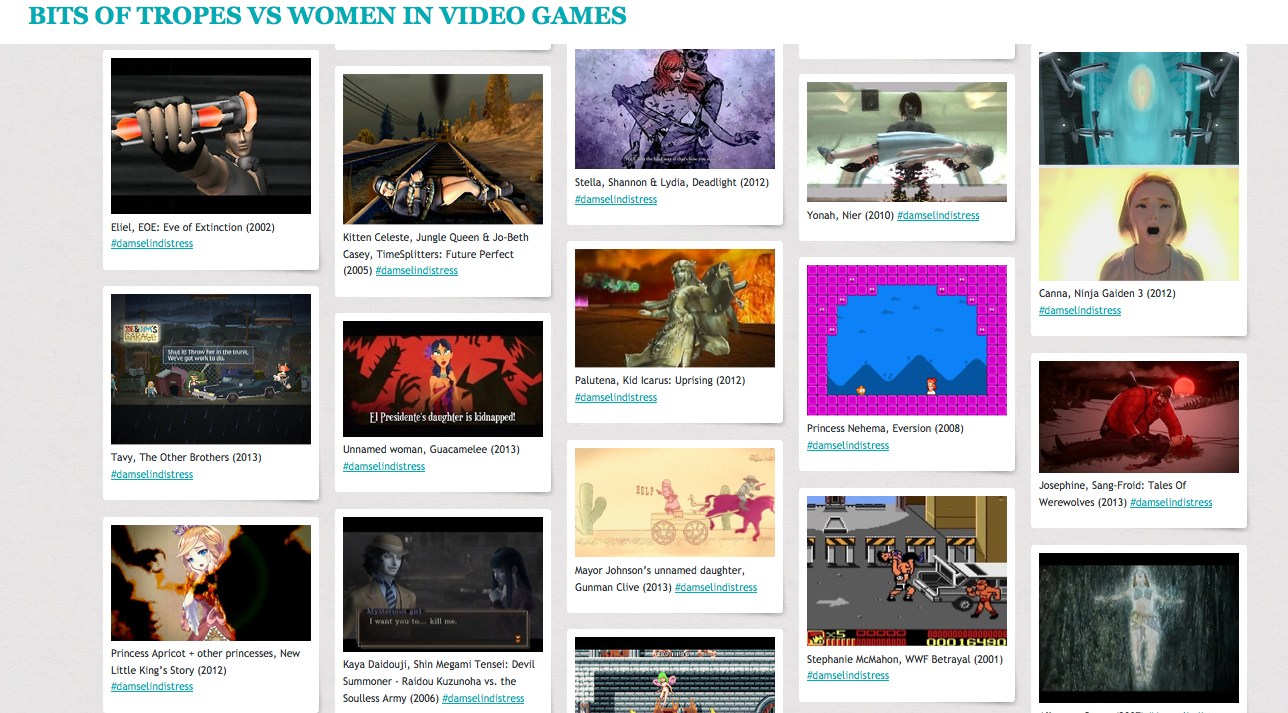
Check out all the example of a Damsel in Distress over at the Tropes vs. Women in Videos Games Tumblr.

The trope of Damsel in Distress not only permeates a large number of games, but it does so in such varying manners as to have subsets.  She examines these subsets not only in how they change gaming, but how they effect and have been effected by additional types of media. And it is so common. These tropes are being used to pump out low quality games with poor storytelling just to force feed the gamer mind. A Forbes contributor, Jen Bosier, said it just as I wanted to, “This isn’t just demeaning to women, it’s demeaning to gamers in general”.
            I want better games, for everyone. And that means creating in-depth stories that are not demeaning for the ever-expanding gaming community. These videos should in some small amount be feared, they are airing out the video games community’s closet and showing the world that, yes, things do need to change. 

-K.

Monday, June 10, 2013

Let's Talk About XBox One Game

I just got done watching Spike’s live coverage of Xbox One and its exclusive game reveals. Granted, I’m not going to purchase an Xbox One, but I thought it would be fun to see some of the trailers for new games. And it was. Until something so repulsive and yet so familiar happened.

A producer for Killer Instinct was playing a game with an Xbox Live employee, Ashton, in order to demonstrate the powers of Smartglass. Ashton quipped in good humor that whomever thought it was a good idea for her to fight the producer of the game was “gonna get it.” She was a good sport about having the producer massacre her at his own game in front of thousands. And then he said, “Just let it happen. It will be over soon.” To which the audience laughed and applauded.

Yes, because the very real threats of violence against women are FUNNY. The world witnessed what non white hetero cis men experience in the gaming world regularly. Ironically, as Microsoft pushes for more ways to connect to others while gaming, this demo clearly illustrates why this might NOT be a selling point for some.

That would have been enough, but the producer kept going. “Wow, you like this,” he said to Ashton. Her response, “Uh, no. I don’t like this.”

My sentiments exactly. “Uh, no. I don’t like this.”

-A. 

Friday, April 12, 2013

Fake Geek Girls, Fake Geek Problems

It is difficult to have a valid discussion on a concept that is so hotly debated. The idea of the Fake Geek Girl exists in a multitude of discussions. Do they exist at all? Does the idea of a Fake Geek Girl have a spectrum? Is one a Fake Geek Girl to the complete exclusion of being an actual geek?  Does the debate of the Fake Geek Girl expand to booth babes, or even just a geek culture naïf? What stressors over the last few years of the geek and gaming community has led to the explosion of negative energy towards the communities female participants?  When the first postings about the Fake Geek Girl hit the Internet it ushered in a flood of reactions both condemning the idea and expanding upon it.

The Fake Geek Girl has a vague definition. Articles by CNN, The Atlantic, and Forbes (several times) contributors explain that FGGs are “pretty girls pretending to be geeks for attention”. One article even drew the FGG infiltration as parallel to the Communist sleeper agent uncertainty of the 1950s. Jokes are cracked and comics and advertisements are drawn about how these FGGs are here to prey on the male geeks as unfeeling huntresses. These comics or short films, while made in jest as a manner to dismiss the FGG, can actually get across some important points. One short film has a humorous depiction of the FGG as a murderer. In it, the detective makes a comment stating that: “Maybe there is no fake geek girl. Maybe it is just a product of the deeply rooted sexism of geek culture. Maybe she is just a manifestation of the insecurities about the opposite sex”.  This is the only somewhat serious part of the film, and it is quickly laughed off and forgotten. Yet, Dr. Andrea Letamendi, who writes for The Mary Sue, explains that this may be the case as well as several other factors.
Pulp Scifi style seems perfect for the silly idea.
Dr. Letamendi explains the situation on both sides: why the male geek population reacted to viciously, and why the female geek population reacted so defensively. She lays it out in three very clear lines. Geeks are afraid of imposters and false infiltrators because: 1) There is a false notion of limited resources within the community, 2) The community has a misinterpreted sense of ownership, and 3) There is resentment for the change that ‘geek’ culture is undergoing. These negative ideas are supported by the fact that, every once in a blue moon, there is a girl just looking to get some attention in a skimpy cosplay, there are still booth babes in many conventions, and fledgling geeks are not given enough positive reinforcement to pursue the culture before being turned away.

Dr. Letamendi also states that female ‘geeks’ become defensive at the idea of the FGG because of long-seated “insults, indignities, and demeaning messages from other members of the comics community”.  She brings up the subtle ways in which female members of the community are belittled, stating the use of microaggressions, to plant a disparaging seed in the female geek’s mind. She also elaborates on the ways women are made to feel invisible within the community, as well as pointing out that female geeks are constantly told that they cannot keep up intellectually with their male counterparts.


There may be a little more to it though.  The introduction of the idea of the FGG to the popular community mindset led to the creation of a new wall.  This barrier, arbitrary in its subject or depth, has to be hurdled every time a female geek wants to participate in the community’s conversations. Every time the wall is faced, the qualifications to be an ‘authentic geek’ changes. Many of the articles about FGGs written by females who consider themselves part of the community start their articles with their geek justifications; a list of how and why they can be considered part of the community. They have to prove themselves, establish their geek credentials, in fear of not being taken seriously.

The itching idea of attractive female non-geeks invading the geek-space for attention without an actual interest in the geek subset of cultural material has been growing for a while. Bans on the use of Booth Babes (another term for a promotional model), female models hired to attract attention to products and product tables at conventions, has been on the scene for a while.  But for them it is different, while they may be at the con for the attention, they are also there for the money, for them it is a job. But the main worry is that this condescending attitude towards ‘pretty invaders’ is now being applied to attractive female geek community members who have, for a long time, felt like a part of the community and are now faced with requests of justification.

-K.

Thursday, April 11, 2013

[TRIGGER WARNING: R*PE] Yes, We’re Still Talking About This Game

In 2006, Japanese erotic game developer Illusion released RapeLay in Japan to little fanfare. In the game you play as a male character who stalks and rapes a mother and her two daughters.

I wish this was a joke.

Sex is an active mechanic in the game meaning that you, the player, can control the sexual acts you force on the female characters. You can choose between a variety of sexual positions and unlock different game modes, each equally as disturbing as the next. You might be wondering, “Well is there a story? Is there a point to all this?” Sure I guess there’s a story, if one could call it that. The main character is arrested for groping one of the female characters on a train. He is bailed out of jail by his father, who is an important politician. After the incident, the main character seeks revenge on the girl and her family.

Three years after the game’s initial release, gamers in the United States caught wind of the title and the media outlets exploded in debate. What is interesting about the RapeLay fiasco is the gamer response to it. A casual review of the game was first featured on SomethingAwful where the reviewer nostalgically recalled (in a tongue-in-cheek manner) the video game days of yesteryear where rape was simple pixels in Custer’s Revenge. He finds RapeLay disturbing but does not outwardly condemn it or any other erotic game featuring rape.

When CNN covered the game, erotic manga artist Nogami Takeshi took offense. He believed that because the game was created for rational adults, the game would not encourage people to become rapists. He says that rational adults are capable of distinguishing from real life and a fictional game so the content of the game isn’t an issue. Many gamers nodded in agreement.

Unfortunately, games are so over saturated with sexualized depictions of women that gamers don’t even blink when a game like RapeLay comes along. Games like this don’t exist in a cultural vacuum, they are reflections of the society in which we live. This isn’t an issue of fiction vs. reality. You can’t just say “It’s just a game so it’s okay.” The game glorifies the systems in place that keep victims of sexual harassment and assault from reporting their experience. The game also plays into rape fantasy and normalizes sexual violence against women. According to the study “Effects of Exposure to Sex-Stereotyped Video Game Characters on Tolerance of Sexual Harassment,” men subjected to hypersexualized images of women in games were disproportionately more likely to tolerate sexual harassment than those who were exposed to non-sexualized images of women. Even if its not immediately obvious, games like RapeLay do have an effect on players’ perceptions.

I find it disturbing that many people did not even question the existence of a game like this or why there are people willing to play it.

- J.

Thursday, April 4, 2013

Harassment: Excuses, Excuses, Excuses

CONTENT/TRIGGER WARNING: Discussion of sexual harassment/threats of sexual assault, links contain potentially triggering material.

When I play World of Warcraft, I always play female toons because honestly, I relate to them. WoW does a pretty decent job of providing clothing that doesn’t drastically change between the genders. I’m not going to stop playing female-bodied toons because men in game feel that they have the right to harass me.

I’m sick of walking into dungeons, being asked my real-life gender over and over again and when I finally concede? I get asked to do sexual favors, to makes sandwiches, “can I feel your boobs? lololol”, “where do you live real life— you’re probably fat”. I’m sick of walking into PvP and being inundated with angry players threatening rape on each other’s mothers and daughters and girlfriends. I’m sick of men loudly proclaiming their relationship status in game as if women are some kind of commodity that allow you to be accepted into gaming communities.

The infamous trolling excuse.
I’m sick of, when I call out these misogynists, being called a "bitch" and told that I should just “laugh it out, they’re just trolling”.

“Trolling” is a universal excuse that basically amounts to “they’re just joking” or “they’re just trying to get you angry”. This excuse is problematic because trolling almost always targets marginalized groups. In gaming, much of the “trolling” I have seen has been targeted towards women, gender and sexual minorities and people of color.

Additionally, a lot of insults used, no matter the victim, are usually gendered or based off of racist/heterosexist ideas. Often times “trollers” will insult people by mis-gendering them or calling them gay.

Essentially “trollers” often get away with making horrible remarks by saying that they’re just kidding. Many people also claim that trollers are only like that in-game, that truthfully they are not racist or sexist.
There are many problematic aspects of these arguments  and unless we deconstruct these excuses, we cannot move past the rampant harassment in the gaming world. If you are truly against racism, sexism and the like, trolling is unacceptable.

Another popular excuse is that people shouldn't be offended by harassment because "it's just the internet". In no other form of communication do we dismiss the words and actions of others based on the form of communication itself. We don't yell at folks over the phone, "Don't get upset, we're on the telephone!". As gaming and online communities become more and more common, we must recognize that the internet is a valid space for communication and that words and actions matter.

(TW for link: Sexual harassment, threats) At Fat, Ugly or Slutty, moderators compile screenshots of thousands of cases of harassment. This website serves as evidence for how rampant harassment in video games really is, and how there are very little repercussions for bullying online. The content of the website is sad, angering and potentially triggering. In reality, though, these screenshots represent the everyday gaming life of many women.
Fat, Ugly or Slutty compiles online gaming harassment directed at women.
Extra Credits, in their video on Harassment, note that harassment online is just a vocal minority of players, the worst part of the gaming community. Whether this is true or not, there is a large part of the gaming community that is complicit in harassment. In the Cross Assault debacle, no one in the room stood up against the sexist harassment. When I've experienced harassment in game, no one has stood with me to stop it. This has to change. We cannot just stand idly by while folks are harassed. Not only must developers do something to police the community, but we as a community must work to police ourselves.

-H.

Friday, March 29, 2013

Glitch and Cooperative Play

Glitch was a flash-based browser MMORPG in which harassment was extremely rare. Plagued by financial difficulties, the game ended in December of 2012. However, in light of the ongoing discussion regarding harassment in gaming communities, I think that Glitch provides an example of a game that was successful in fending-off player harassment. Glitch accomplished this in a number of ways, and admittedly perhaps its status as a small indie game didn't harm it either.

Glitch was a relatively unique MMO in that the game itself did not encourage aggressive competition among players. There is no Player vs. Player combat, and there were only rarely instances of Player vs. Environment combat. These rare PvE situations encouraged the cooperation of numerous players for the benefit of the game. A large part of the game was exploring the continuously expanding in-game world and learning new skills. Glitch fostered a cooperative MMO environment using a number of techniques.

Scene from the tutorial

One such technique was the utilization of Quests requiring another player. Quests gave players goals and rewards. A number of these Quests could only be completed through asking the participation of another player who did not get the same benefits of the Quest-holder. However, given the frequency of these cooperative Quests, Glitch encouraged an environment where helping another player for little immediate benefit was the norm (with the assumption that other players will do the same for you in the future).

Another variation on the Quest are those that specifically encourage aiding low-level players. Because Quests are provided to players based upon their level and previous Quests, certain Quests are only revealed at higher levels. One of these is a Quest to give items to brand new players. Often these items are ones that new players would be unable to attain on their own. I find these strategy of the game developers particularly brilliant as it sets up a support system for new players and improved community integration. Instead of the trope of gamers being hostile to newcomers who are perceived as "fake" or "noobs," Glitch encouraged acceptance of newcomers. When I personally completed this Quest, for example, the new player sent me a friend request and we continued to play together until the game's end.

Similarly, Feats were akin to global "Quests." That is, every player had the opportunity to participate in it at the same time. These Feats almost exclusively required generosity or cooperation. Examples include leaving complete strangers gifts at their homes or playing mini-games with other players. At the end, players who participate were rewarded with Feat-specific items.

Casting this rainbow on another player gives them more energy but does nothing for the caster.

A reflection of this cooperative community in-game ethos was evident in the use of community resources. In Glitch, there were a number of areas with community resources, such as gardens for example. It would be easy for players to continuously take from the gardens and never give back, simply selling the harvested items for profit. If this was the attitude in-game, the gardens would simply remain empty. However, it was rare to see a community garden with empty plots. For the most part, players were cautious to only take what they needed and frequently re-planted. Passers-by would sometimes stop to water a dry sprout so it would continue its growth, an action that drained the player's energy with no return. In this way, nice behavior was the norm even outside of Quests and Feats.

While Glitch was unusual in that it was almost completely without combat, it was quite usual in other ways as an MMO: it had a global chat, you could send players private messages, and there could be competition in other ways (levels gained, items gained, etc). The potential for harassment was there. However, by utilizing Quests and Feats that "game-ified niceness," Glitch to a large extent successfully avoiding allowing that type of environment to develop. This game-ification of cooperative play and nice behavior I believe has the potential to decrease harassment in other games, even those with a combat-based style of play.

-A.

Thursday, March 21, 2013

League of Legends and the Gamification of Politeness

League of Legends, an online action real-time strategy game, has a lackluster player community known for its harassment and bullying. I was hesitant to start playing for this reason. It didn’t help that II was unfamiliar with team-based strategy games. Once I got started, however, I found myself having a lot of fun defending team towers and reading up on the best strategies for my favorite characters. Even though I was having fun and trying my best, I was not good at the game. I was bullied for my poor skills and even reported by another player for “feeding”, intentionally dying to throw the game and spite your teammates. People called me a “noob”, people told me “u suck”, and people told me to “stop playing.” So I did.

Two players defend their team's tower against enemy minions.
That was two years ago and since then Riot Games, the developers behind LoL, have implemented strategies to reduce harassment and bullying. To foster a friendlier gaming community, Riot Games encourages players to abide by the "Summoner’s Code":

I. Support Your Team
II. Drive Constructive Feedback
III. Facilitate Civil Discussion
IV. Enjoy Yourself, But Not At Anyone Else’s Expense
V. Build Relationships
VI. Show Humility in Victory, and Grace in Defeat
VII. Be Resolute, Not Indignant
VIII. Leave No Newbie Behind!
IX. Lead By Example

To promote the tenants of the Summoner’s Code, Riot introduced the The Tribunal System. It enables the wider community to determine what kind of behavior is and isn’t appropriate. It “...identifies players who have been consistently reported by the community over a large number of games and builds a Tribunal case for them. These cases are presented to random community members who use the Tribunal who then review the case files and render a judgment—pardon or punish. Player Support then uses this information to help assign the right penalties to the right players.” The Summoner’s Code is suggested as a guideline to use when deciding cases.I recently tossed around the idea of playing LoL again but still worried about the player community. Voicing these concerns to my brother, a frequent player, he stated “Oh, the community is much better now. It’s like they gamified being polite.” In addition to reporting abusive players, people can now rank others for being a good team player, being helpful, and a variety of other positive characteristics. Players receive in-game awards for having a positive reputation. At the end of the game season all players with a certain reputation level receive a limited edition item, further incentivizing good behavior.

Riot is also not afraid to punish abusive high-profile, professional players. Recently, two pro players were temporarily banned from competing in competitions. When two people on a professional team are banned from competitions, this means the rest of their team can't compete because their down teammates. It shows that when one person misbehaves, multiple people are negatively impacted. This also serves as a public example to players that harassment and bullying is not tolerated. Hopefully, good sportsmanship amongst pro players will have a trickle down effect on the more casual ones.

While their the system Riot has implemented has its flaws, their efforts demonstrate that even the worst gaming communities can change if developers (and players) take the initiative to build a positive community.

-J.